Songs
from the Inside is a brilliant documentary series
currently on Maori TV about four musicians coaching inmates at Arohata and
Rimutaka to write their own songs.
The documentary is a welcome antidote to
“reality TV”. Both the producer Maramena Roderick and director Julian Arahanga
are very aware that they do not want to create a prison version of Idol.
There are so many shows today glamorizing
the cops and encouraging us to identify with their brutality - like Highway Patrol - and an endless stream of
crime shows trying to make us support the police and ‘law and order’ panics. Songs from the Inside cuts against all
of this, and all of the right-wing ‘law and order’ politics of both main
parties from the last decades. It is not afraid to show colonization, racism,
loss of language and culture, and oppression, as issues that lead to so many
young Maori men and women ending up in prison.
What the documentary manages to do is
portray both the musicians - Anika Moa, Warren Maxwell, Maisey Rika and Ruia Aperahama
- and inmates’ relationships developing throughout the series in a breathtakingly
honest and brave way. The openness and trust that develops between them allows
the documentary to explore issues of sexuality, drugs, crime, and remorse. And
above all, the documentary humanizes
the inmates/students so that viewers can identify and relate to them.
Even though the show isn’t explicitly
political, in today’s New Zealand media culture telling those stories is a
radical move.
Songs
from the Inside is on Sundays 8PM.
Previous episodes can be watched on demand
Listen to the
interview featuring the producer and director of Songs discussing these issues and more with Kim Hill
Blair Peach was murdered at the hands of the Metropolitan Police on 23rd April 1979. Blair was an east London teacher who had gone to Britain from New Zealand. He was also
a member of the Socialist Workers Party (SWP) and the Anti Nazi League. He was
killed protesting at the Nazi National Front (NF), which was holding a meeting
in the predominantly Asian area of Southall, west London.
Amidst a climate of crisis and terror - as the FN in France celebrate a big vote in the presidential elections, and as the mainstream media report Breivik's hate-filled fascist testament from Norway - the causes Blair gave his life for, anti-racism and anti-fascism, have lost none of their relevance or urgency.
We reprint an article from the British Socialist Worker below, which was first published to mark the 25th anniversary of Blair Peach's death. A further article from 2010 provides updates on the long campaign to bring Peach's killers to justice.
The International Socialists celebrates Blair Peach's life as a socialist, unionist, teacher, and anti-racist. We will mark his memory by continuing the struggle against oppression and racism here in Aotearoa.
***
"As the police rushed past him, one of them hit him on the head with the
stick. I was in my garden and saw this quite clearly. He was left sitting
against the wall. He tried to get up, but he was shivering and looked very
strange. He couldn't stand. Then the police came back and told him, 'Move! Come
on, move!' They were very rough with him and I was shocked because it was clear
he was seriously hurt."
This was the shocking testimony of Southall resident Parminder Atwal, one of
the witnesses to the murder of Blair Peach at the hands of the Metropolitan
Police on 23 April 1979. Last Friday, 25 years after his murder, a piece of
artwork was unveiled and a memorial meeting held in the area where he was
killed.
Blair was an east London teacher who had come over from New Zealand. He was
also a member of the Socialist Workers Party (SWP) and the Anti Nazi League. He
was killed protesting at the Nazi National Front (NF), which was holding a
meeting in the predominantly Asian area of Southall, west London. His police
killers still walk free.
The National Front had announced it would hold a "general election" meeting
in Ealing Town Hall on Monday 23 April 1979. Local people were appalled. They
knew that fascist meetings bring fascist violence. Three years earlier an
NF-inspired gang had stabbed Gurdip Singh Chaggar to death in Southall.
But the local Tory council gave the Nazis Ealing town hall to meet in. Local
people did all they could to get the meeting banned. The day before 5,000 people
marched to the Town Hall.
Southall Anti Nazi League activist Balwinder Rana recalls, "The march was
attacked by the police, who picked fights all along the way." The then Labour
home secretary, Merlyn Rees, refused to ban the meeting. Three thousand police,
with dogs, horses, riot vans, a helicopter and units of the notorious Special
Patrol Group poured into Southall.
At lunchtime Southall's shops closed in protest at the Nazi meeting. Some
factories shut down and Asian workers at nearby Heathrow airport walked out.
Anti-Nazis arrived in Southall in solidarity. At around 3.30pm some
demonstrators tried to get on a bus going through the police cordon. The police
threw everyone off. Those arrested included Mr Rihal, on his way home to look
after his wife who had just left hospital.
The police later lied and said he had damaged the bus. He got three months in
jail. As Balwinder recalls, "At about 6.30pm people started to go towards the
town hall. Suddenly the cordon parted and police on horseback came through and
started to hit people with long batons. They attacked men, women and children."
Police vans speeded through the hemmed-in crowd.
Inside the Nazi meeting the local NF candidate was pledging to "bulldoze
Southall to the ground and replace it with an English hamlet". People outside
were confronted with a full-blown police riot. The Daily Telegraph recorded what
happened:
"Within three minutes mounted police had cornered about 50 demonstrators
against the churchyard walls. As we watched, several demonstrators were dragged
crying and screaming to the nearby police station. Nearly every demonstrator had
blood flowing from some injury."
The police surrounded 6 Park Road, which been designated a first aid and
advice centre. The police kicked the door in and forced everyone to run a
gauntlet of truncheon blows to get out.
Local activist Clarence Baker had been told earlier by the police, "You black
bastard. We are going to get you." He remembered, "About six were hitting me
with their truncheons. I felt one blow. I did not feel anything after that."
Clarence ended up in intensive care with a blood clot on his brain. At least
three protesters were hit so hard their skulls fractured. Blair Peach was one of
them. "At least two Special Patrol Group vans came up," remembers Blair's friend
Jo Lang, who chaired last week's memorial meeting. The officers got out and
charged us. We ran, but Blair wasn't with us. So we went back to look for him.
An Asian family had taken him into their living room. You couldn't see how badly
injured he was. It was later said that he was hit with a lead-filled cosh. While
he was in the ambulance he started having fits. At 12 o'clock they phoned and
told us he was dead."
News of his death sent shock waves through the British working class. The day
before he was buried 4,000 local Asian people filed past Blair Peach as he lay
in Southall's Dominion Cinema. Throughout the night Southall youth maintained a
guard of honour over him. The next day the cortege travelled to east London.
Bengali people from Brick Lane, who Blair had stood with against Nazi terror,
paid their respects. There were 13 national union banners on the 10,000-strong
funeral procession. TUC president Ken Gill spoke at the graveside alongside Tony
Cliff of the SWP.
When the lockers and some houses of Special Patrol Group members were later
searched coshes, knives, bayonets, swords and Nazi regalia were found. The unit
was later disbanded. But since then the police have been consistently deployed
to defend Nazi events: from Bradford to Welling in south London, and in
Birmingham and Manchester last weekend.
The first round of the French presidential election has revealed a dramatic
rise in support for Marine Le Pen’s fascist Front National (FN).
Le Pen came third in the exit polls with 18 percent, behind the Socialist
Party's François Hollande (29 percent) and the current right wing president
Nicolas Sarkozy (27 percent). The FN’s support, up from 10 percent in 2007,
represents around 6.5 million votes, the most ever won by the French extreme
right.
How has this situation come about?
Mainstream commentators point to the FN’s “softer” image under Marine Le Pen
as evidence that it has become more moderate. This is false. She may have made
cosmetic changes to the party's public image, but the self-styled “revolutionary
nationalists” who created it in the early 1970s always aimed to adapt fascism to
present day conditions. She is still pursuing this strategy.
Over the past five years the FN has become the main beneficiary of Nicolas
Sarkozy’s obsession with “national identity.” His presidency has combined
austerity measures with a grotesque “bling-bling” lifestyle and the most
relentlessly racist agenda of any modern French president.
The government has established and ruthlessly implemented deportation quotas
for “illegal” immigrants. Roma camps have been smashed up and a vicious and
sustained attack has been launched on France’s Muslim population. The state has
decreed what Muslims should wear and where they should pray—by banning the
wearing of the niqab in public and outlawing praying in the street. Sarkozy’s
election campaign featured attempts, following Le Pen’s lead, to create moral
panics about halal meat and Islamic fundamentalism.
The Islamophobia of politicians and parties across the political spectrum has
legitimised the FN. This has made it easier for millionaire’s daughter Marine Le
Pen to masquerade as an opponent of the “elite” and its austerity measures. She
proclaims her party to be “the only opposition to the ultra-neoliberal
left.”
Sarkozy and Hollande will now contest the second round of the election on 6
May. Polls suggest that Hollande is likely to win.
Despite the shock of the FN vote, the left has achieved its highest overall
first round score since 1988. This was made up of support for Hollande’s
programme of “fair austerity” and those who voted for Jean-Luc Mélenchon’s Left
Front. His proposals for wealth redistribution and ecological renewal won 11
percent, with 1.2 percent voting for the New Anti-Capitalist Party.
Mélenchon rightly argues that the Sarkozy-Merkel axis at the heart of the
European austerity project must be broken. The left has therefore to ensure
Sarkozy is defeated in the second round.
Although the radical left vote is lower than anticipated, it indicates
significant support for an alternative to austerity. An employers’ offensive is
going to follow the second round, whoever wins. Fighting this will require a
movement of industrial and political resistance that achieves maximum unity.
This means the left needs actively to confront the Front National and the
tide of Islamophobia that has made racism respectable in France. The
consequences of its failure to do this so far are there for all to see today.
But so, also, is its potential to provide solutions to the crisis of French
society.
The FN can be defeated. In the 1990s anti-fascists mobilised against its
meetings and engaged in “democratic harassment” of the organisation. This helped
provoke a damaging split in the party from which it is only now recovering.
On the eve of the election Mélenchon derided Le Pen as an abomination—“the
Yeti of French politics”—and “a road-mender of the crusades”. He compared those
who argued “Better Le Pen than Mélenchon” to those who argued “Better Hitler
than the Popular Front” in the 1930s. The comparison is valid. The task now is
to translate fine words into action.
Mark your diaries and start spreading the word: march on Friday 11th May, 7pm from Waitangi Park to protest homophobia and transphobia. More information from The Queer Avengers here. The event is also on Facebook.
[For theory and background reading see Norah Carlin's classic "The Roots of Gay Oppression", and this archive of articles on LGBTI theory and struggle]
[Iraq war veteran Phil
Aliff wrote this for the U.S. socialist website Socialist Worker earlier in the
week. As the current round of NZ SAS meddling in the region draws to a close,
it is of particular relevance here. We also recommend the SW articles “A warthat guarantees atrocities” and Helen Redmond's “An accepted part of the occupation”]
THE LAST few
weeks have been catastrophic for the U.S./NATO occupation of Afghanistan. Days of
violent protests against the U.S. military followed the burning of Korans at a
military base in late February, leaving scores dead and injured. Then,
38-year-old Army Staff Sgt. Robert Bales left his outpost before dawn on March
11 and murdered 17 Afghan civilians.
The news of
this tragedy evoked memories of incidents such as the My Lai massacre in
Vietnam and raised new questions for Americans about whether the war in
Afghanistan can really still be called "the good war."
The
atrocities committed by Bales in Kandahar province, the historic home of the
Afghan Taliban, cost the lives of four men, four women, two boys and seven
girls in two villages. Since the
massacre, the U.S. military has struggled to contain what it considers a
"public relations" nightmare by focusing the blame on this individual
soldier who suddenly "snapped"--as if the problem of overstressed
soldiers is limited to a "few bad apples." This is the military's
common refrain in previous instances in which soldiers have committed
atrocities as part of the "war on terror."
But this is
merely a smokescreen used to avoid addressing the fundamental questions that
such atrocities raise about the role of the U.S. around the world, as well as
the pattern of utter disregard for people touched by these conflicts--whether
Afghan or American--that U.S. officials have repeatedly demonstrated.
In order for
the occupation to be carried out, dehumanizing Afghans is a necessity of U.S.
military strategy. Islamophobia and disregard for the Koran are mainstays of
military life. This is exacerbated by the fact that occupation inevitably
breeds resistance, which explains why the U.S. easily toppled the Afghanistan's
Taliban government more than 10 years ago, but now faces the prospect of
humiliation in the longest war in U.S. history.
- - - - - - -
- - - - - - - - -
IN THE first
chapter of The Forging of the American Empire, author Sidney Lens
explains that the idea that the U.S. is a benevolent superpower is based on the
"myth of morality":
America the benevolent, however, does not exist and never has
existed. The United States has pilfered large territories from helpless or
near-helpless peoples; it has forced its will on scores of nations, against
their wishes and against their interests; it has violated hundreds of treaties
and understandings; it has committed war crimes as shocking as most; it has
wielded a military stick and a dollar carrot to forge an imperialist empire
such as man has never known before.
This has
never been clearer than now. The war in Afghanistan has cost thousands of lives
and destabilized Central Asia. Yet U.S. officials trumpet the military
occupation of a country half a world away as a mission in the service of human
rights, democracy, the liberation of Afghan women and the protection of
Americans from terrorism--all while creating conditions that lead to tragedies
like the recent massacre.
U.S.
officials celebrate their "close collaboration" with "our allies
in Afghanistan"--while subjecting Afghans to drone attacks, violent night
raids, increased poverty and dehumanizing interactions with NATO occupation
forces. It's the white man's burden all over again--bringing civilization
through barbarism, destroying the village in order to save it.
This is bound
to generate a growing fury, and yet the U.S. military can't seem to understand
why Afghan soldiers and police might vent their resentments on their
"benevolent masters." It is this
clash--between the official rhetoric about Afghan allies on the one hand and
the reality of despair and anger among actual Afghans on the other--that
creates the strain on U.S. soldiers, a constant anxiety that any Afghan man,
woman or child might be the enemy. And if anyone and everyone is a potential
enemy, then anyone and everyone is also a potential target.
As the call
for war intensified in the days after September 11, the U.S. looked to
Afghanistan as the first step in a grand military campaign to reshape the
Middle East and Central Asia.
The U.S.
invasion of Afghanistan was motivated by far more than just revenge. It was
meant to secure one of the world's key oil pipeline corridors and demonstrate
U.S. power in a region close to China and Russia, the two most powerful
competitors to U.S. imperialism.
In order to
maintain the occupation, the U.S. has relied on President Hamid Karzai, who is
now known as the "Mayor of Kabul" because of the inability of the
central government to exercise any significant control over Afghan territory
beyond the nation's capital.
Karzai, who
was one of the mujahedeen's chief fundraisers during the Soviet occupation of
Afghanistan and a CIA contact, has done nothing to increase social and economic
mobility for Afghans. Instead, he has absorbed warlords with a long list of
human rights abuses into his government and overseen one of the most corrupt
countries in the world--all with U.S. backing.
- - - - - - -
- - - - - - - - -
THE SITUATION
is bleak for most Afghans--particularly women--caught in the vise of a
decade-long war with no clear end in sight. According to a 2010 UN study on
poverty in Afghanistan, 36 percent of the population lives in absolute poverty,
while another 37 percent lives just above the poverty line. This is despite an
estimated $35 billion in aid that flooded the country between 2002 and 2009. According to
a Thomson Reuters poll in 2010, Afghanistan is ranked as the most dangerous
country in the world for women. This is despite the justification that the U.S.
is occupying Afghanistan in order to liberate women. According to an Afghan
government report, 2,300 women attempt to kill themselves each year, mainly due
to factors such as poverty and domestic violence.
Indiscriminate
air strikes are another characteristic of the increasingly dangerous situation
in Afghanistan. The use of drone aircraft and airstrikes has increased
dramatically under the Obama administration and routinely affects women and
children, such as the bombing of civilians in May 2009, which killed up to 120
people in the province of Farah.
The last
decade of warfare has not only produced a horrific situation for the people of
Afghanistan, but also for U.S. service members who are facing a mental health epidemic.
According to
a Pentagon study, the number of service members hospitalized for suicidal
thoughts increased by 7,000 percent between 2006 and 2011. The number of
soldiers diagnosed with posttraumatic stress disorder (PTSD) rose six-fold
between 2003 and 2008.
Despite the
statistics, many soldiers are repeatedly deployed with mental health issues,
increasing the likelihood of tragedies such as the massacre in Kandahar
province. The blame for the mental health epidemic in the military also cannot
be attributed to a "few bad apples"--unless, of course, those bad
apples are sitting in the Pentagon.
The Army
systematically ignored the health of Sgt. Bales, who was on his fourth
deployment. Bales clearly needed care for PTSD as well as a traumatic brain injury
reportedly suffered during an earlier deployment.
The idea that
this is an isolated incident only deflects blame from the military leaders and
the Obama administration, who have ignored this epidemic for years.
The Koran
burning, pictures of Marines urinating on Taliban corpses, the bombing of
wedding parties and the massacre carried out by Bales are related. The
dehumanization of Afghans, along with the mental health epidemic in the U.S.
military, has created the conditions for these atrocities to occur.
The only way
to end the ongoing commission of atrocities in Afghanistan is a complete
withdrawal of all NATO forces from the region. The decade-long war has been a
nightmare for Afghans and U.S. soldiers alike, costing thousands of lives and
creating fundamental instability in Afghanistan and Pakistan. Every day the
U.S. remains only exacerbates this already bad situation.
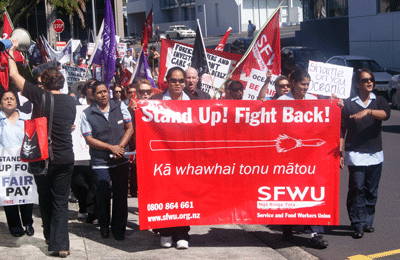
Low
paid aged care workers and nurses were out on strike again on 19th
March. The action was at 22 out of Oceania’s 57 homes, which are run on public
money for private profit. They have our full support. Their stand is an example to other workers, and shows that workers in all industries can stand up and fight back.
Oceania
pay their care givers an appalling basic rate of just $13.61, a smidgen above
the minimum wage that will be $13.50 from April. Qualified nurses are paid more
of course, but less than in the public sector. They only get $8.33 on top of
basic when they work a weekend shift. Oceania’s
latest offer is a miserly 1.72% increase, but only from February and not
backdated to last June when the last collective agreement expired. But the
offer is worse than even this because Oceania want to cut overtime rates.
As
paymasters the government are partners in this crime. Oceania got a 2.6%
increase in their public funding last June but refuse to pass it on to staff
pay. In a labour-intensive service industry John Key is effectively capping pay
to below inflation levels.
What
should be done? For starters the union movement should raise a storm of protest
and not leave the Oceania unions SWFU and NZNO to battle on alone. The SWFU and NZNO strikes are an inspiration, and have drawn others into the union and into struggle. Two SFWU delegates from Oceana spoke to a Unions Wellington meeting last Friday and talked of the determination of union members on the picket lines. But the care
givers left to fight by themselves have little
industrial power, and illegal solidarity strike action by workers in sectors with greater power is
unrealistic. However, the Council of Trade Unions (CTU) and all unions could
back the strikers’ public protests to the hilt by calling on members to join in.
We marched with the watersiders, we can do the same in town after town with the
Oceania workers and the elderly folks’ families.
It
is not only the greedy Oceania owners who need to be exposed. The politicians are
responsible for the elderly care service being run for profit. Quite simply
Oceania and the other private outfits should be nationalised without
compensation. The public already pay for the care for the elderly. Why should
profit be skimmed off at the expense of poverty pay and minimal standards?
Those false friends of workers, the Labour Party, could make nationalisation a
manifesto policy and pledge to make elderly care the quality public service it
should be. Keeping the status quo means condemning women care workers to
poverty pay indefinitely, because that is what privately contracted publicly
funded services are designed to do. Only as a public service could women care
workers ever get the recognition they deserve for a demanding job that, let’s
face it, few men have the skills
to do. Unless Labour, and the Greens, take up the call for nationalisation their
support for the care workers is nothing but hogwash.
There
is another false friend abroad, and that is the call for New Zealand ownership.
Bryan Gould wrote an otherwise excellent piece on the dispute, but lamented
that Oceania was Australian-owned (New Zealand Herald, 14 March 2012).
“Like most overseas owners, Oceania have
little knowledge of and even less interest in the welfare of their New Zealand
workers - to say nothing of New Zealand customers and taxpayers.”
“The real goal of privatised companies is
profit, not service. We cannot prevent privatised firms - despite the
government's obfuscation on this issue - from falling into foreign hands.
Enterprises owned overseas have little concern for the interests of their
workforce. New Zealand workers are increasingly at the mercy of hard-nosed employers.”
Quite
frankly this all-New Zealanders-together nationalism is nonsense. The for-profit
elderly care service is a made in New Zealand construct. It operates under New
Zealand made anti-union labour laws. There is no evidence at all that New Zealand
employers are better to their workers than Australian; in fact it would be easy
to make an argument to the contrary. But it is not a question what set of
employers have better morals because all capitalists have the same immorality,
to exploit and make the most profit possible. The New Zealand ruling class is
as greedy as any and gets away with it more than most. The main enemy is at
home. The real question Bryan Gould should be asking is how do we build a
workers’ movement powerful enough to get rid of the profit system.
Pay the Oceania workers’ 3.5% claim today!
Nationalise the elderly care service and
pay women a living wage tomorrow!
[Photo Credit: Service and Food Workers' Union website. Look out for details of how to support the strike action coming on Easter Thursday, 5th April]
The most expensive
case in New Zealand history, and for what? Millions of dollars have been spent
on a vindictive and farcical prosecution, at the cost of untold stress, emotional
harm and upset for the people of Tuhoe. In Februarywe calledthe treatment of the Urewera Four an
“anti-democratic outrage”, and stand by that today. The police case continued
for reasons of malice and political mischief – there were gains to be made in
creating a ‘terror’ threat. Tuhoe, yet again, have borne the burden for that.
A police officer
responsible for the case was quoted on National Radio this morning as saying he
‘wasn’t hung up’ on jury decisions. Well he might say this; in 2007 the police
tried to make out that they had busted up an imminent terrorist threat. As the
months and years went on plank after plank of their lurid War on Terror fantasy
fell away. All that is left now are a gaggle of firearms charges, and even many
of those were thrown out by the jury.
The government and the
Police owe Tuhoe an apology. Ruatoki was attacked, and I deliberately use the
word attacked, as school buses were searched by armed police, kaumatua and kuia
were illegally detained, men and women were man handled and mistreated all for
a few firearm charges. Charges that are so remote from what the Police were
alleging. It’s a sorry affair.
Hone Harawiracalls the decision“justice denied”, and reminds us of
vital context:
Yesterday should have been about the triumph of
justice, but it wasn’t. All we got a sad and sorry end to a tragic raid into
the heartland of the Tuhoe because after all the drama, the high expectation
and grainy videos, yesterday the jury could only return guilty verdicts on firearms
charges. That’s all we got after a four year campaign that cost the taxpayers
millions of dollars, divided the nation, and gave people genuine reason to fear
the police.
Because today, justice is still denied to the people
of Tuhoe.
Today the case may finally be over but not for the
people of Tuhoe. There has been no apology, no compensation, no change in
police operations and no new engagement policy initiated as a result of the
litany of errors we now know as Operation 8.
Today we remember those who have passed on since
2007. Today we remember the pain and suffering brought upon the people of Tuhoe
by the state … again.
Today I commit the energy and the support of the
MANA Movement to standing against those who would use the Terrorism Suppression
Act and the Search and Surveillance Bill to crush independent thinking, to
force us to fear what we say and to hide what we do and to stop us from
choosing freedom over oppression.
And today I salute Tame Iti and his comrades for
their dignity, for their courage, for their passion and for their love for this
land.
This trial was the latest in a long history offrame-ups
and politically-motivated prosecutionsaimed
at damaging and disrupting the movement for Tino Rangatiratanga. Attacks in the
past have never succeeded in destroying that movement. This one won’t either.
Tuhoe deserve full compensation and an apology from
the government and the police for the outrages carried out in Ruatoki.