Showing posts with label Culture. Show all posts

Wednesday, 17 October 2012

Film Review: American Radical: the Trials of Norman Finkelstein


Film review by Andrew Tait

"Every single member of my family on both sides was exterminated. Both of my parents were in the Warsaw Ghetto uprising. And it is precisely and exactly because of the lessons my parents taught me and my two siblings that I will not be silent when Israel commits its crimes against the Palestinians."

It is a tragedy to be born out of your time, when keeping faith with your past means breaking radically with the present. This documentary about radical Jewish American academic Norman Finkelstein is more gripping and tragic than any documentary about an academic should be.

If Israel had a public enemy list for intellectuals, Norman Finkelstein would be number one. He is a figure held up for derision and hate for Zionists for two reasons: He is the foremost and most fearless critic of the Israel's racist theory and increasingly barbaric practice and worse, he is a Jew whose parents survived Hitler's concentration camps. This last is the worst crime in a critic of Israel. For a state based on Jewish identity Finkestein's Jewishness is galling but his direct link with survivors of Hitler's attempted genocide is unforgivable.

His parents loom large in this documentary.

They are ever-present points of reference for Finkelstein, who grew up in the long shadows cast by the watchtowers of Auschwitz.

He says of his mother that she was always reflecting on the camps, on the smallest events as if they revealed the secret of human nature.

His father, who became a factory worker in New York after the war, spoke little of the camps, or anything else.

The horrors of the Holocaust meant the Finkelsteins were unusual parents. When they said the simplest things, like share your things or don't waste food, simple lessons that all parents pass on to their children, Norman's parents were deadly serious because in the camps the basics of human decency were not a luxury but the only thing left to cling to give life any meaning at all.

On war, specifically the American war in Vietnam, Finkelstein's mother was almost hysterical in her opposition, he said - “why would people do such things? How could they?”

Finkelstein was animated from his high school days by a horror of injustice and cruelty, so anyway said a former classmate who now lives in Tel Aviv. Everyone was against the war in Vietnam but Norman was serious about it. He was passionate.

When Israel invaded Lebanon in 1982, Norman's opposition to war collided with the increasingly brutal trajectory of the “Jewish” state.

Israel bases its right to existence on the supposed eternal hostility of non-Jews to the Jewish people, who depend on the security a nation state brings. Israel bases its right to mete out violence and destruction on the enormous violence meted out to European Jews by the Nazis. How can the bombing of Lebanon and Gaza be compared to the death camps, to the annihilation Hitler sought to bring upon the Jews? The Holocaust Industry (the title of one of Finkelstein's books) exists, he argues, to use the legacy of that time to justify the state of Israel. The Holocaust is like an inexhaustible bank account of horrors that Israel can draw on – in a more moderate, “democratic” way, more in sorrow than anger – and pay forward to the Palestinian people.

Finkelstein is a real problem, not just because of the strength of his arguments or the depth of his historical knowledge (which is great) but because as a child of the Holocaust he is in a way a trustee of that legacy of genocide.

His arguments and his knowledge are deeply significant though. Isolated though he might appear to be now – Finkelstein was driven out of his teaching positions at two US universities and has been detained and deported from Israel – if you were to survey Jewish intellectuals of the last 100 years it would be the Zionists, not Finkelstein, who would be in the minority. Socialism in one form or another was the mainstream political ideology of European Jews up until the Holocaust.

Finkelstein's mentor, Noam Chomsky, is a great example of this progressive anti-capitalist tradition that Finkelstein also represents.

Nonetheless, the times are against him and he is a lonely figure. In some ways, this is self-inflicted. Finkelstein could have kept his radical politics and his condemnation of Israel as a sideline to, say, rebutting the Holocaust denier David Irving or US imperialism. Instead he has chosen the more difficult path, to make what is closest to his heart his life's work. He is a passionate public intellectual. He is a prophet.

Friday, 25 May 2012

Book Review: The Lacuna


How do you write a history of revolutionary lives and activity in the mid 20th century and sell it to the public? A tough order, certainly, but Barbara Kingsolver nails it with The Lacuna. 

The book follows the life of a young man, Harrison Shephard, who finds himself living between the worlds of his Mexican mother and American father. He attends high school in New York during the great depression and the Bonus Army riots, and describes the desperation and anger which filled the streets during those days. He returns to Mexico to serve in the home of Mexico’s most famous artists and communists – Diego Rivera and Frieda Kahlo. Eventually, the household grows to include those homeless revolutionaries-in-exile, Natalia Sedova & Lev Bronstein -  better known as Leon Trotsky. Following a split in the relationship between host and hosted, he serves for several years as one of Trotsky’s secretaries and finally, he finds himself living back in the country of his birth, the USA, where he has to live with his communist past, as well as a few “dirty little secrets” of his own, in the deep dark days of McCarthyism.

Though the person of Harrison Shephard is fictional, the people and social scene was real and is described in incredibly thoroughly researched detail. I cannot conceive of a more accessible account of Trotsky’s life in Mexico. Kingsolver does a fantastic job of describing his attitudes to the various struggles which occur during the years of the book, his relationship with Diego, Natalia and especially Frieda, and ultimately, his murder at the hands of a Stalinist agent.

Binding the whole story together is Harrison's understated but touching narration, and that of his eventual assistant. This medium presents the principle players in a sympathetic light, and brings out a touch of the people behind the legends. It also provides an interesting insight into small town life in the US after the second world war.
All in all, this book is an absolute masterpiece. For people interested in a picture of the lives of some of the key revolutionary players in the Americas in the pre-war period, you’d be hard pressed to find better. Alternately gripping and touching, a must read for all.

Kevin Hodder

Sunday, 6 May 2012

The Tyranny of Slenderness


By Rowan McArthur


The body often shows us the physical manifestation of the brunt of our physical, emotional and spiritual exploitation under capitalism. Just as a worker in a factory may be cursed at by their bosses for not working fast enough because of pain in their hands and backs from hours of repetition, so too do we get cursed and abused by capitalism for our bodies’ physical manifestations of the exploitation we experience in our everyday lives.

Everywhere we look we see the image of the ‘perfect body’, an emaciated body is projected onto us by this exploitative system as a way to repress the majority who cannot conform. An emaciated body, representing the emotional, spiritual, mental and physical hunger we all experience under an economy based on exploitation and profit, rather than human need. A body that everyone wants but no one can achieve; for this body is not real. Just as the body on the billboard advertising the latest fashion, has been warped, cropped and coloured to trick us into believing that the emaciated and sick is beautiful, so too does capitalism warp, crop and colour our exploitation to blind us of the reality of this sick and corrupted system. This body dominates our thoughts and conversations as well as those who judge us by it. It dominates how we feel about ourselves. It dominates our television screens and creates huge amounts of profit for fashion, weight loss clinics, pharmaceutical companies, cosmetic surgeons and other parasitical industries feeding off the vulnerable. This body represents perfectly the unsustainable system which dominates our world, but sadly it also represents the domination and emotional hunger experienced in many people’s lives.

This is the tyranny of slenderness!

This emaciated body has not always been the ideal for women to conform to. There was a time under capitalism that a curvaceous woman was the picture of beauty. So why has this changed? Why do so many women strive for the pre-pubescent, boyish figure which we are brainwashed into thinking is normal for a grown woman? Why do almost all women think that a size 12 is fat? Why are most women not happy with the way they look? Why do we live in a society where people starve themselves to death or eat themselves into oblivion?


There are so many places to point the finger too, but more than often we point it ourselves or at one another rather than pointing it at those who impose their ideologies upon us for their own benefit. How often do we judge those people walking down the street who do not fit in the box of a ‘healthy weight’? All too often there are snide remarks and laughter which follow those who are overweight or gasps and looks of horror at those who no longer eat. Both those who eat to a point of excess and those who starve themselves are representing the lack of control we have over our lives. Some people feel that the only thing they can control is what they eat and so when they realise they cannot control any other aspect of their lives they restrict themselves from participating in one of the fundamental acts of keeping ourselves alive.

The anxiety girls and women experience from feeling unattractive is arguably one of the most pervasive and damaging consequence of advertising and mainstream media. Only one body type is almost always presented in the media and in advertisements -- that of a very tall,thin woman -- a woman who would meet the criteria for anorexia as 15% below normal weight. In reality, this unhealthy body shape is unattainable for 99% of women.

Eating disorders are a symptom of a sick society.  A society that celebrates thin women in the media, advertising, film and chastises women deemed overweight. 'A WOMAN can't be too rich or too thin.' So said the Duchess of Windsor, and so says every fashion and beauty magazine, every television ad, every weight loss centre and even many families, friends and doctors.


The most well-known eating disorder, anorexia nervosa, is the third most common chronic illness among young women. Anorexic women suffer from the perception that they are overweight, when they are in fact often dangerously thin. Other common eating disorders include bulimia nervosa, in which a person binges and then purges themselves (usually by self-induced vomiting), and binge eating, in which a person cannot control their desire to overeat. While some men experience eating disorders, over 90% of people with them are women.

Naomi Wolf’s book The Beauty Myth (1990) powerfully documents the effects of the unattainable body ideal on women's physical and mental health, and indicts the fashion, cosmetics and plastic surgery industries, which benefit from women's misery to the tune of billions of dollars a year.

These profits are made by creating a deep sense of dissatisfaction amongst millions of women about their bodies, a dissatisfaction that is growing with the growing gap between the 'ideal' body and reality.

Media images do have a powerful effect, but they are also continually reinforced in everyday life. Comments on women's appearance are so commonplace and accepted that we can underestimate the effect they have on how women see themselves.

These powerful media images indicating a thin women is a good women are affecting people at a younger and younger age. In some disturbing statistics presented by the British journal of psychology half of three to six-year-old girls say they worry about being fat. By the age of seven, 70 per cent of girls want to be thinner. By nine, half have been on a diet. For girls aged between 11 and 17, it’s their number one wish in life. This may seem surprising, but when you think of the images seen in advertising, billboards, magazines, films and TV which glorify and focuses on thin actors, actresses, models and other ‘successful’ and ‘important’ figures it doesn’t seem so surprising after all.

In a study of children’s movies and books for messages about the importance of appearance, media targeted for children were heavily saturated with messages emphasizing attractiveness as an important part of relationships and interpersonal interaction. Among the movies used in the study, two Disney movies contained the highest amount of messages about personal beauty. This study also found 64% of the videos studied portrayed obese characters as unattractive, evil, cruel, unfriendly, and more than half of the portrayals involved the consideration or consumption of food.

Representation of overweight individuals in prime time programming is not representative of the actual proportion in the population. Only 14% of females and 24% of males featured in the top ten prime-time fictional programs of 2003 were overweight. Those that were shown had few romantic interactions, rarely shared affection with other characters, and were frequently shown consuming food.

Many times, even these "beautiful" women are deemed not good enough for advertisements. Photographs are airbrushed or otherwise altered to remove any lines, bumps, or lumps - anything less than "perfection." If the ideal of beauty is physically unattainable, then consumers will never be able to attain the image they want, and therefore there will be an endless demand for new beauty products.

This is the reason for the incredible proliferation of the weight-loss, fashion, and cosmetics industries, which are among the largest and most profitable consumer industries.

As a result, the millions of women and girls who are unable to reach this standard of beauty feel a sense of failure, shame, and guilt. In 1984 a survey of 33thousand woman was taken showing that most women would choose loosing 5 to 7kg over success in work as their most desired goal. This clearly shows how this desire to be thin infiltrates out from women’s individual lives into the advancement of their careers, participation in their unions and the political arena. Naomi Wolf describes dieting as the most potent political sedative in women’s history. The concern about weight leads to a virtual collapse of self-esteem and sense of effectiveness in women’s lives.

This change in perception of women’s ideal body came into being as a dominant feature of women’s everyday lives can be linked to women’s liberation movement of the 60s and 70s. The Women’s liberation was leading to a more assertive, politically clear, self-confident woman, the opposite traits of women concerned about their weight. What Naomi Wolf describes as caloric restriction was a means to take the oomph out of our desires to be treated as equal and has warped the struggle for our liberation from a mass movement into an individual struggle against our own bodies.

The distorted, unattainable, sexist mass images are a product of the exploitation of women as wage workers, unwaged domestic labourers and sex objects. They are an inevitable consequence of (and prop for) a system in which those with power benefit from the exploitation of women in the home and the workplace. Undermining women's self-confidence not only keeps them buying more and more products in their struggle to attain an ideal, but also helps to keep them from challenging their roles.

Campaigns to change the images without changing the social conditions which produce them and give them their power can advance things only so far. Legislation to ban particular types of advertisements, or regulating the size and shape of fashion models, doesn't challenge the basis upon which it is so lucrative for industries to use such images to sell their products.

The most effective way to combat sexist images is to develop a mass movement which aim to change women's unequal living conditions in a whole range of spheres and out of which alternative images, will develop. This will also challenge the nuclear family structure, the unpaid work in the home which the majority of women undertake and the pay gap between women and men. But further than this women’s liberation cannot be achieved by women alone, it has to be a part of a working class movement, intent on creating equality for all oppressed groups not just for women. A working class movement is the only way to completely topple and smash this tyranny of slenderness!


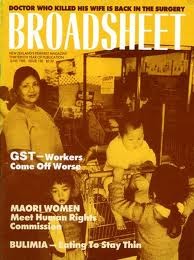
[An image of Broadsheet, New Zealand's pioneering left-wing feminist journal. The women's liberation generated a whole array of radical publications, theories, and organisations.]


Wednesday, 25 April 2012

TV Review: Songs from the Inside


Songs from the Inside is a brilliant documentary series currently on Maori TV about four musicians coaching inmates at Arohata and Rimutaka to write their own songs.

The documentary is a welcome antidote to “reality TV”. Both the producer Maramena Roderick and director Julian Arahanga are very aware that they do not want to create a prison version of Idol.

There are so many shows today glamorizing the cops and encouraging us to identify with their brutality - like Highway Patrol - and an endless stream of crime shows trying to make us support the police and ‘law and order’ panics. Songs from the Inside cuts against all of this, and all of the right-wing ‘law and order’ politics of both main parties from the last decades. It is not afraid to show colonization, racism, loss of language and culture, and oppression, as issues that lead to so many young Maori men and women ending up in prison.

What the documentary manages to do is portray both the musicians - Anika Moa, Warren Maxwell, Maisey Rika and Ruia Aperahama - and inmates’ relationships developing throughout the series in a breathtakingly honest and brave way. The openness and trust that develops between them allows the documentary to explore issues of sexuality, drugs, crime, and remorse. And above all, the documentary humanizes the inmates/students so that viewers can identify and relate to them.

Even though the show isn’t explicitly political, in today’s New Zealand media culture telling those stories is a radical move.

Songs from the Inside is on Sundays 8PM. Previous episodes can be watched on demand

Listen to the interview featuring the producer and director of Songs discussing these issues and more with Kim Hill


Shomi Yoon