Thursday, 13 September 2012

National Day of Action Against Welfare Reform


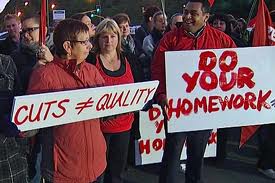
So Bennett/National is at it again attacking the poor, mothers, the sick and disabled. Threats of cutting benefits in half if people don't conform to bureaucratic "solutions" to child health and education... 

But excuse me who ends up missing out when the benefit is cut in half? Why does Aotearoa have increasing poverty and social problems?

It's certainly not the beneficiaries who caused the world
 economic crisis and high unemployment.
It's not beneficiaries who created the fastest growing gap between rich and poor in the OECD.

It's not beneficiaries who are pushing more and more people below the poverty line.

We need to the stop government from blaming the poor and oppressed for the social problems we face today. 

We need to stop the government trying to solve these social problems by taking more resources away from the poor and oppressed.

We need to stand up and say No to cuts to welfare. We need to stand up for those who have no voice. 

Join in the National day of action for the rights of beneficiaries on the 5th of October!"

Find out details of the national day of action here. Facebook page for the Dunedin event here.

Rowan MacArthur

Friday, 7 September 2012

Aotearoa: the State of the Class Struggle


During the whole of 2011 there were a mere 12 work stoppages and they involved barely 2,000 workers and only 4,850 person-days lost (to exploitation); so says the Department of Labour. Even worse, only 9 of the 12 stoppages were actual stoppages. The other 3 were what the DOL calls ‘partial strikes’, which are not strikes at all but actions short of a strike, such as go-slows and overtime bans.

These statistics started with 1986 when there were over 200 stoppages. Since then the strikes trend has been steadily downwards. 2010 had 18 stoppages, but 2011 surpassed that record low. Had the working class lost all fighting capacity? Could things get any worse?

We now know the answer to these questions and that a corner has been turned; 2011 will be the nadir. By comparison, the first months of this year saw a veritable explosion of strike actions, involving 1,500 aged care workers, 1,300 meat workers and 300 wharf workers.

It was in the nature of the times that these struggles were defensive; against attacks by the employers. The outcomes are heartening. The aged care dispute was settled in June with a 3.22 pay rise and preservation of overtime rates and other rights that were under threat. The meat workers saw off an attack on the union and won a contract. The Maritime Union humbled the Ports of Auckland Ltd to defend direct employment and conditions.


When pushed too far workers have demonstrated resilience and tenacity to resist attacks. There can be no doubt that the employers nationally have taken note, and that what threatened to be a general management onslaught on working conditions has been diffused to some degree. However, the class struggle waged by the capitalists goes on. KiwiRail’s Hillside Workshops were put up for sale in May and may be sold by the time this article is read. Solid Energy is prettying itself up for privatisation by sacking miners. The cutbacks taking place across the public sector are relentless.

A lot of the attacks on jobs and services are hard to organise resistance around, particularly piecemeal attacks that do not bind a lot of people together in the same boat at the same time. Contrast with when the government launched a frontal attack with their plan to cut teacher numbers nationwide. Hekia Parata sparked such a reaction in the educational establishment that she had to back down.

Continuing out theme of strike trends, the last four months have been ones of a reversion to quietude. The question of eroding living standards is a slow burning fuse. It is impossible to predict when the overdue workers’ pay revolt will occur, only that it will. Hard times, unemployment, put workers on the back foot. History teaches that a pick up in the economy often brings about a recovery of workers’ confidence and strikes.


The New Zealand economy is in a bad way, but the government doesn’t admit it and the nation’s complacent news media scarcely reports on it. Gross Domestic Product for the year to March was up 1.7% on the year to March 2011, but this is a pretty low figure for a recovery from the 2008-2010 recession. The weak performance has not been enough to boost employment. Basically, the unemployment rate has not changed since the worst of the recession. Unemployment actually increased by 4.3% over the year to June. At the last count there were 162,000 unemployed, an unemployment rate of 6.8%. These figures would be much higher but for the exodus of workers to Australia. There were a record 53,900 departures to Australia in the year to July, more than offsetting total immigration. The comparatively buoyant Australian economy is acting as a safety valve. It provides New Zealanders with an individual solution, rather than to stand and fight collectively.

Part of the problem is on the political side. The Labour Party, and the trade union bureaucracy drawn behind it (whether formally affiliated or not), is proving unable to inspire visions that society under a Labour government would be any better. This is hardly surprising as Labour under David Shearer is sailing so close to National’s politics that the difference is hard to detect. Labour will not even commit to reversing National’s privatisations and spending cuts. Workers are not getting any call to arms from this quarter.


In summary, the state of the class struggle today is one characterised by a continuing lack of confidence by workers to take collective action. The lack of confidence continues from the political and economic setbacks from the mid-1980’s onwards, and is currently held low by economic conditions. But (an important but), the strikes of earlier this year demonstrate that when pushed too far workers will fight back. The employers and the government continue to tread wearily lest they provoke a reaction. 

Thursday, 6 September 2012

Australia: CFMEU Stands Up

[The dispute between Grollo and the construction workers' union - CFMEU - in Australia is extremely important, and has lessons for unionists in New Zealand. Here Jerome Small, CFMEU member and Industrial Organiser for Socialist Alternative in Australia, reports on the struggle.]


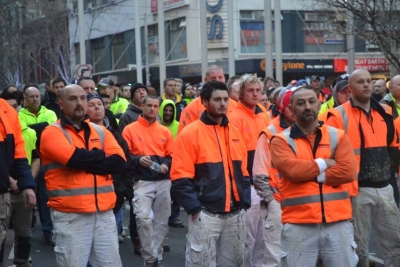
The police are prepared for a bloodbath. Row upon row of cops stand behind a temporary fence that keeps picketers well back from the giant construction site. Behind them more police, with Alsatian dogs on leashes.
Police horses gather on the corner of Swanston Street, prepared to charge on construction workers. There is no shortage of riot police to back them up. Early morning commuters parking in the QV Centre are startled by the sight of hundreds of riot police in the basement car park, banging batons on their shields as they work themselves into the frenzy required to batter unarmed human beings.
Altogether, probably over a thousand police are mobilised to smash the picket line. The ambulance service has been notified, and emergency departments are on standby for the expected casualties.
These are the scenes from central Melbourne last Friday, and repeated this morning (Tuesday). Ted Baillieu’s police force is backing-up the giant construction company Grocon in its bid to run sites without on-site union representation.
After the hysterical press campaign last week about the supposed “reign of fear” and “union thuggery” on Victoria’s construction sites, we saw clearly on Friday, and again on Tuesday, who is willing to use sickening levels of violence to enforce their will: Ted Baillieu’s police against workers standing up for their rights.
This reflects the enormously high stakes in the battle between Grocon and the main construction union, the CFMEU. The outcome of the dispute will have an impact for years to come in the construction industry.
A win for the company will mean that the biggest sites in Melbourne will proceed without any effective union presence – a massive defeat for one of the most militant and effective unions in the country. A clear win for the union will signal to the whole industry that the slow spread of shonky, non-union contractors can be brought to an end.
In fact, the implications reach far beyond that. Despite taking some hits from a series of vicious anti-union laws, the CFMEU has maintained an active presence on the vast majority of commercial construction sites in Melbourne. This puts it head and shoulder above unions in many other industries in Australia, where decades of defeat and retreat mean that full time shop stewards and active organising are a distant memory.
The capitalist press is bellowing about a return to the “bad old days” of industrial disputation in the 1970s, when workers and their unions won decent wages and conditions in a series of bruising industrial battles. This reflects a fear that the Grollo dispute will revive union fortunes not just in construction but beyond.
So it is no surprise that a conga line of right wing hacks, newspapers and employer bodies has formed, demanding blood be spilled to break the picket. The Australian Industry Group complains of “militant and unlawful” behaviour from the CFMEU, the Victorian Chamber of Commerce condemns “intimidation and harassment” from the union, while the Master Builders’ Association goes with “illegal and reckless”.
What they mean, of course, is “effective”. It is perfectly legal to join a trade union, and even to picket, so long as you aren’t effective in stopping production – one of the most serious crimes in a profit-driven society. Just last month, a NSW boss was fined just $30,000 after 15-year-old Kevin Hadfield was dragged into a metal lathe, lost his arm and then died. No front page screaming from the papers and politicians about that.
In July, Toll Holdings was hit by an effective picket line at a warehouse in Somerton, Melbourne, that it operates for the supermarket giant Coles. The company was forced to give major concessions to the union. So it is no surprise to find Toll’s chief executive Brian Kruger showing his solidarity with Daniel Grollo, calling for “more significant penalties, particularly in terms of fines or potential jail time” against picketers.
Victorian Liberal premier Ted Baillieu has called for deregistration of the CFMEU, which would stop the union from negotiating legally-binding enterprise agreements. He has talked tough, threatening to rewrite the Riot Act in order to more effectively sweep pickets out of the way. And his attorney general has sought to join the contempt of court action against the CFMEU, adding to the massive legal and financial pressure being brought to bear on the union.
Federal workplace relations minister Bill Shorten has joined this chorus, declaring that “the blockade is a terrible idea, and the mob should get off the street”, and denouncing the tactic as “industrial stupidity”. Shorten’s “smart” way is to let the union be sidelined, and he openly welcomed the fact that small numbers of scabs have crossed the picket line on Friday and again on Tuesday.


Faced with this enormously powerful list of enemies, our side has only one weapon – solidarity. This dispute is shaping up as potentially the most important industrial battle since the MUA dispute of 1998.
On that occasion, mass pickets of thousands on a daily basis kept the docks shut. The thousands of rank and file construction workers who have been calling past the Grocon picket in Lonsdale Street every morning – many answering a call from their union, others just turning up – are the basis of this kind of response.
Beyond that, serious contingents from the metals construction division of the AMWU and smaller groups from the Maritime Union, the Firefighters Union, the National Union of Workers, the Australian Services Union and many others have also appeared at the picket over the last week. Many of them are workers repaying a debt of solidarity to construction unions, who have supported innumerable disputes – from the nurses to the Coles Somerton dispute – over the years.
The Victorian Building Industry Group of unions, which includes the CFMEU, the Electrical Trades Union, the Plumbers Union and the AMWU, has endorsed a state wide strike to support the picket in the event of a serious police attack.
The CFMEU strategy since Tuesday has been to avoid a physical confrontation on the picket line. A small number of scabs, mostly managers and other non-productive employees, have been able to access the site under heavy police escort.
But as of Tuesday afternoon, there has been no production on site for two weeks. The reality is that building sites need more than labour. They need a vast amount of material delivered daily, and they need concrete delivered and pumped. To do all that requires clear access for trucks to the crane bays.
It is one thing for Victoria Police to get access for a small number of scabs. It would be an even more massive and ongoing operation for them to clear the streets and keep them clear to allow access for material – especially the continuous convoy of concrete trucks necessary to pour a slab. Even the most massive police operation will have a hard time doing this on a daily basis against determined mass pickets.
Grocon boss Daniel Grollo has reportedly taken on a mountain of debt in order to buy out other family members from the family business. For the last couple of weeks, servicing that debt has looked difficult if not impossible. He has faced disruption on a number of jobs, and pretty much the only thing moving on his landmark Lonsdale Street Myer job has been the pigeons.
However, this standoff can’t last indefinitely.
Grollo has rejected out of hand the idea that his legal action and the union’s blockade could both be lifted to allow talks. This and the extraordinary police deployment, the ferocious attacks of the press, and the open proclamation of Australia’s business elite all point in the same direction. Our rulers are prepared to deploy massive force to batter a key union into submission.
Well over a thousand construction workers have, over the last week, made it part of their daily routine to call past the picket from 5am. Thousands more have made it clear they are prepared to descend on the site at a moment’s notice if the union gives the call. Outside of construction, traditions of solidarity have awoken again – especially in blue collar workforces with a union tradition.
It is these workers in their thousands and tens of thousands who can, if called into action, stop Grollo in his tracks – and strike a vital blow in turning the tide for workers and our unions in Australia. 

Wednesday, 29 August 2012

Dunedin: It's Bitter with the King


On Saturday the 26th of August along George Street, Dunedin, a rather important protest took place. This protest was regarding the sub-standard way that Burger King is treating its hard-working staff, something that must be analysed seriously by the citizens of any democratic nation. This includes, but is not limited to: paying Burger King staff minimum wage for years and years, regardless of if they're a supervisor, or sometimes even manager (in one case about 15 years!), paying under minimum wage under the guise of "training modules", and trying to push their workers away from Trade Unions. Every worker has the right to join a union. 
     
Unite Union and ISO organised and performed this as Burger King staff did not want to protest personally for fear of retribution. The protest started organising itself around the Robbie Burns Statue, we jokingly placed a Unite Union flag in Robbie Burn's hand, and then we descended into George Street, finishing at the Meridian Shopping Mall, which has a Burger King on the bottom floor, making the chants and general protest very well heard by the staff, and hopefully management.  
 
The protest was generally considered to be quite well done, as we gained a lot of public attention, spread awareness, and hopefully gained support among Dunedin workers and shoppers. People from the street even started protesting alongside us! From the Robbie Burns' statue to the Meridian shopping mall, we marched and chanted "Burger King, get stuffed! Minimum wage is not enough!" "Grill your burgers, not your workers!" "When workers' rights are under attack! STAND UP! FIGHT BACK!" "When I say Union, you say power! Union! POWER! Union! POWER!" All of this was performed in the hope that Burger King staff knows that they deserve to be treated better, and so the bosses know they can't treat their workers like punching bags full of cash. 

Find out more about the campaign at Unite Union news

Jasper Auld

[Image credit: Unite Union flickr stream.

Marching for Marriage Equality


At least a thousand people showed out today to support a bill being introduced to parliament today, which would amend the Marriage Act to allow marriage between same sex couples. While many would argue that marriage is an institution best avoided, that doesn't change the fact that it is a right, with many associated legal benefits, denied to many couples simply because they are of the same gender. 

But there are no fundamental rights - only what we win in struggle. Equal marriage is the right to marry who you want. It matters in a million petty bureaucratic ways to the couples and it matters to everyone who is hates injustice. When bigots are beaten, everyone wins.


The thousand who turned out today was composed not only of those who are directly affected - queer individuals and couples - but also a great many straight supporters. The message was clear - you don't need to be queer to support equal rights, and this is borne out in every poll on the issue in NZ over the last few years. Marriage equality is but the first step in a long struggle for equal rights for queer individuals, but unlike 30 years ago, when the very right to legally exist had to be fought for, tooth and nail, today the pressure is on parliament to get with the times. But that's not to say there won't be resistance. 

The social conservatives and the religious right would have us return to the days when it was illegal to be gay, and marriage was when a wife was a chattel sold by her father to the highest bidder. No way!

This bill needs to pass, and we need to build organisations which will not only ensure that Marriage Equality becomes a reality, but also be prepared to tackle not just the next struggle for queer rights but to fight, arm in arm, straight and queer, for equality for all.


Saturday, 18 August 2012

Massacre at Marikana Mine - Solidarity with Labour in South Africa!


Amandla! Ngawethu!


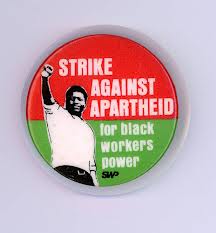
I, and most people in the anti-apartheid movement in New Zealand, took part in the boycott campaigns not to simply change the colour of the faces of those who ruled South Africa. We didn’t face batons and barbed wire to replace race-based apartheid with economic apartheid. Our intention wasn’t to stop the apartheid gravy train for the wealthy just long enough for a tiny number of the black elite to jump on.

John Minto recently made public his correspondence with the organisers of a conference happening in Wellington this weekend celebrating NZ’s role in the struggle against apartheid. How tragically immediate these words are!

Police in South Africa have massacred over 30 striking miners in the Marikana platinum mine, one of the most violent attacks on labour since the end of apartheid, and a horrific act reminiscent of the Apartheid state’s brutalities at the 1960 Sharpville massacre in the Gauteng (Transvaal).

Amandla, a radical magazine in South Africa, call this "a brutal tragedy that should never have happened," and editoralise:

No event since the end of Apartheid sums up the shallowness of the transformation in this country like the Marikana massacre. What occurred will be debated for years. It is already clear the mineworkers will be blamed for being violent. The mineworkers will be painted as savages. Yet, the fact is that heavily armed police with live ammunition brutally shot and killed over 35 mineworkers. Many more are injured. Some will die of their wounds. Another 10 workers had been killed just prior to this massacre.
This was not the action of rogue cops. This massacre was a result of decisions taken at the top of the police structures. The police had promised to respond with force and came armed with live ammunition. They behaved no better than the Apartheid police when facing the Sharpeville, 1976 Soweto uprisings and 1980s protests where many of our people were killed.
The aggressive and violent response to community service delivery protests by the police have their echo and reverberation in this massacre.
This represents a blood-stain on the new South Africa.

Media coverage has stressed the complexity of the inter-union rivalries, but the involvement of the police – and the shooting down of striking workers – makes it clear what is involved. “The Marikana action is a strike by the poor against the state and the haves, argues Justice Malala.

The old slogans from the anti-apartheid struggle have a new relevance. Once again, we say “Solidarity with South African labour!”

Amandla! Ngawethu!


***
Striking South African mineworkers were gunned down by police on Thursday. Charlie Kimber looks at events leading up to the massacre—and the business interests behind it

Police in South Africa have opened fire at striking workers at the Marikana platinum mine near Rustenburg, leaving at least 18 people dead. Ten people have died over the last few days in other clashes.

This disgusting slaughter evoked memories of how the police acted during apartheid. All the hope at the end of that vile racist regime has come to this.

The recently appointed police chief Mangwashi Victoria Phiyega visited the mine a few days ago and she is believed to have coordinated Thursday’s action.

But the decision by the heavily armed police to use live rounds must have been endorsed at the highest level—perhaps even by the ANC’s President Jacob Zuma.

Zuma said he regretted the killings. But disgracefully he made no reference to the handling of the situation by the police.

There must be justice for the strikers killed at Marikana—and those who ordered the deaths must pay for them...


[Read the full background story and analysis from Charlie Kimber at Socialist Worker]


Sunday, 12 August 2012

Honouring Past Struggles: Whangamata Protest 2008

In July 2008, Hauraki Māori and other community members of Whangamata occupied the proposed car park area of the Whangamata marina. What led them to this point?

Te Matatuhi (the marina site) is the ancestral name of tangata whenua for the specific lands subject to the proposed marina. Te Matatuhi is land of particular significance to Ngāti Whānaunga. ‘Mata’ in both Whangamata and Matatuhi refers to the black volcanic rock obsidian. Mata has long been a principle reason for why Maori live in Whangamata, as the rock was widely sought after for its fine cutting edge. The harbour facilitated trade and many battles were fought in the area.
Various Pākehā business figures had eyed up the Te Matatuhi as a place to build a marina from the mid-twentieth century, but it wasn’t until 1992 that the Whangamata Marina Society was formed and approved the district council to buy the land. In 1996 hearings began on the Whangamata Marina Proposal. Te Rūnanga a Iwi o Ngāti Tamaterā, Ngāti Whānaunga, Te Kupenga o Ngāti Hako, the Whangamata Maori Komiti and other iwi groups consistent in their opposition to the marina proposal from the start and made many submissions and appeals.

The reasons for the iwi groups’ opposition to the marina were extensive, and included the following concerns: that the marina would destroy traditional fishing grounds due to significant and ongoing dredging of the channel where their kaimoana grounds are, a lack of respect of the ancestral ties to Moanaanuanu Estuary and Whangamata Harbour, destruction of wetlands which are important to bird life and the endangered moko skink, and removal of public access to the beach.

The next milestone of the marina was March 2006, when the then Minister of Conservation refused consent. His decision was judicially reviewed by the marina developers and sent back to him, then passed on to the then Environment Minister in the interests of transparency. He allowed the marina to go ahead in December 2006 provided that strict conditions were met regarding containment of dredged materials during construction and monitoring of the world famous surf break at the estuary's entrance. In the first half of 2008, there were several changes to the proposal.
Approximately 30 Hauraki Maori and community members occupied the proposed car park area of the marina for 18 days in July 2008 until they received assurance from Environment Minister Trevor Mallard that he would review the consent process. One of the reasons they felt occupation as necessary was to raise awareness about the changes to the marina development over recent months that the community had not been privy to because they were all processed on a non-notified basis. Spokesperson Nathan Kennedy [Ngāti Whānaunga] was quoted as asking, “what happened to access for all under the Foreshore and Seabed legislation?”
When the marina was built, Waitangi Tribunal Claim Wai 262 had not yet been completed. This is a wide-ranging claim about the management, use, and commercialisation of indigenous flora and fauna, and thus may have had impact on what happened in Whangamata.
Sadly, the outcome of the occupation was that in September of 2008 the marina society began construction without all obligations being met. Several rare species were displaced or exterminated for the development, including the rare Oligosoma moco skink. The marina opened in November 2009.

Juliet Thomberson