Showing posts with label International. Show all posts

Tuesday, 16 October 2012

A wave of anti-US protests in Okinawa


[This article by Khury Petersen-Smith first appeared in Socialist Worker US]


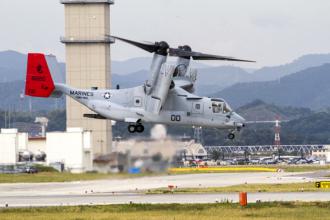
THE DECISION by the U.S. and Japanese governments to deploy the Osprey MV-22 military warplane to Okinawa, a Japanese island south of the mainland and north and east of China and Taiwan, has sparked a wave of mass protest.
The largest demonstrations to date took place in a simultaneous mobilization on September 9 when 100,000 people gathered in Okinawa, thousands of people surrounded the Diet (Japanese legislature) in Tokyo, and protests were held on Ishigaki and Miyako Islands as well as the city of Iwakuni on the mainland, where Osprey aircraft are currently stationed.
The Osprey has tilting rotors that allow it to take off and land like a helicopter, but it also has fixed wings so it can fly like an airplane. These qualities, along with the fact that it can fly four times further than the helicopters that it is replacing, give the Osprey appeal as a tactical vehicle for the U.S. military. However, the Osprey is prone to crashing--there have been two Osprey crashes so far this year, in Morocco and Florida.
The deployment of the Osprey to Marine Corps Air Station Futenma, located in the densely populated city of Ginowan on Okinawa, comes with obvious risk to the civilian population.
"We refuse to accept a deployment of Osprey that has already proven so dangerous," said Ginowan Mayor Atsushi Sakima at the September 9 protest, according to the English-language news site Japan Update. "Who is going to take responsibility if they crash onto a populated neighborhood?" In 2004, a U.S. military helicopter did crash into a building at Okinawa International University.
Kazuhisa Kawamura, principal of Ginowan's Futenma No. 2 Elementary School--which is located just 200 yards from the Marine air station--is worried about an accident involving the Osprey. "The aircraft fly right over our school every day," he said in a recent report by National Public Radio (NPR). "It's frightening."
- - - - - - - - - - - - - - - -
THE CURRENT wave of demonstrations is only the latest in a history of Okinawan protest against the U.S. and Japanese governments following the Second World War--and the deployment of the Ospreys is only the latest injustice in a bitter history of crimes against the Okinawan people.
While August 1945 is generally understood in the U.S. to be the end point of the Second World War, the war did not end for Japan until April 1952 when the U.S. occupation formally ended. And when the Treaty of San Francisco re-established Japan as a sovereign country, exception was made for the southern prefecture of Okinawa, which remained formally occupied by the U.S. until 1972.
The deal under which Japan allowed Okinawa to remain under U.S. military rule is considered one of many betrayals in which Okinawa has been sacrificed by the Japanese state for Tokyo's--and now Washington's--strategic aims. Today, Okinawa bears the burden of more than half of the U.S. troop presence of 50,000 soldiers, and three-fourths of Washington's military bases in Japan. The Okinawa prefecture (similar to a state) comprises only 0.6 percent of Japan's total land area--fully 20 percent of the prefecture belongs to Washington's bases.
Okinawa's tropical climate and location have made it ideal for training and stationing of U.S. troops there. U.S. bases in Okinawa were central to the U.S. war in Vietnam in the 1960s and '70s, played a critical role in the 1991 and 2003 invasions of Iraq and the 2001 invasion of Afghanistan. The Pentagon continues to regard the Okinawa bases as strategically invaluable.
But the cost to the prefecture has been heavy. According to Closethebase.org, a website run by a coalition of peace groups called the Network for Okinawa, there were 1,434 incidents and accidents related to training exercises by U.S. forces between the end of the formal occupation and 2008. During the same period, there were 5,584 cases of U.S. military personnel committing crimes against Okinawans.
Sexual crimes, in particular, have been a disturbing and constant feature of the U.S. military presence in Okinawa. In the recent movement against the Osprey's deployment, many commentators referenced the last great wave of Okinawan protests against the U.S. military in 1995, sparked by the rape of an elementary school girl by three U.S. Marines.
This past is impossible to separate from the current protests. In the words of anti-base activist and professor at the University of the Ryukus Kosozu Abe, "Without Okinawa's history, our opposition to the Osprey wouldn't have materialized. This forced deployment is symbolic of what we have experienced in the past."
- - - - - - - - - - - - - - - -
THE OTHER factor that can't be ignored in the deployment of the Ospreys is Washington's new strategic interests in the Asia-Pacific region.
The Obama administration has coined the term "pivot to Asia" to describe a whole set of steps that the U.S. government is taking to militarize the region in preparation for growing conflicts with China.
This includes deploying a majority of the U.S. Navy's fleet to the Pacific Ocean (it had been previously split evenly between the Atlantic and Pacific); stationing more U.S. troops in the region; increasing the already large U.S. military presence in Hawaii and Guam; greater military cooperation with partner states, including Vietnam, Philippines, Thailand, Malaysia, South Korea, Indonesia and Japan; and the introduction of more weapons.
The U.S. deployment is designed to help ensure that Washington shapes the economics and politics of Asia for the foreseeable future. In a November 2011 article in Foreign Policy magazine, titled "America's Pacific Century," Secretary of State Hillary Clinton wrote, "From opening new markets for American businesses to curbing nuclear proliferation to keeping the sea lanes free for commerce and navigation, our work [in Asia] holds the key to our prosperity and security at home."
U.S. officials are very explicit about preparing for a military conflict with China in the future. The U.S. is anticipating this confrontation because of China's rise as a world power, but it is also ensuring it by threatening China with its escalation of weapons and forces to the region.
The horrible prospect of a future war with China, however, shouldn't stop us from seeing the violence of Washington's "pivot" as it is unfolding right now. The deployment of Ospreys and the more forceful U.S. presence in Japan have already had negative consequences for ordinary Japanese.
For example, when a U.S. serviceman stationed at the Atsugi Naval Air Facility in Kanagawa Prefecture raped a local Japanese woman in July, police were prevented from arresting him by the Japanese government. According to the magazine Shukan Bunshun, supervisors at the local police station were told: "Because of the problems with deployment of the Ospreys, an incident involving the U.S. military might have repercussions, and is undesirable"--and therefore, they weren't allowed to issue a warrant for the serviceman's arrest.
With this latest chapter of Washington's violent history in Japan unfolding, the outpouring of Okinawan protest is very hopeful.
The movement has been building for some time throughout the prefecture. In the Yanbaru Jungle, home of the largest base in Okinawa--the Pentagon's Jungle Warfare Training Center--residents have sustained a five-year long sit-in to stop the construction of new helipads, which is where the Ospreys would land if they are ever built.
Opposition to the Ospreys is uniting Okinawan society, including peace groups, trade unions and elected officials from across the political spectrum. As Australian Okinawa solidarity scholar and activist Gavin McCormack wrote in a September op-ed in Ryuku Shimpo, "This is no longer an opposition movement, but a prefecture in resistance, saying 'No.' Japanese history has no precedent for this."
Takeshi Onaga, the mayor of Okinawa's capital, Naha and member of the conservative Liberal Democratic Party, described the situation this way in the New York Times: "Anger has been building up like hot magma beneath the surface, and the Osprey could be what finally causes an eruption. If they force the Osprey onto us, this could lead to a collapse of the U.S.-Japan alliance."
On October 9, Okinawa's governor Hirokazu Nakaima and Ginowan Mayor Atsushi Sakima met with Japan's Prime Minister Yoshihiko Noda to urge the removal of the Ospreys.
As more plans for the Osprey come to light, the demonstrations are spreading. While the U.S. and Japanese governments have kept the routes for the Ospreys' training flights a secret, an Osprey sighting last week revealed that the routes extend over cities in Kochi Prefecture, leading to protests there.
Elsewhere in Asia, Korean peace activists in Gangjeong Village are waging an heroic struggle against the construction of a base on Jeju Island. The base, which South Korea's government insists is for Korean purposes only and won't be used by the U.S. is nevertheless understood by activists as another local aspect of the U.S. plan in the region. But the Korean, Japanese, and U.S. governments are vulnerable to these social movements, which represent an alternative to another century of war in Asia.

Saturday, 6 October 2012

Syria's Revolution: Bloodied but Unbowed


With the regime of Bashar Assad desperately trying to cling to power, the death toll has risen to 30,000 fighters since Syria's revolution began. Simon Assaf argues for Socialist Review (UK) that the revolution remains popular, non-sectarian and led by Syrians themselves, despite the claims of some commentators

It is a bitter war that has engulfed Syria - one that has transformed the Arab world's most popular revolution into a struggle that can only end in the defeat of Bashar Assad's regime, or the death of the revolution, and with it any hope of change. At the heart of this revolution is the demand for an end to one-party rule, arbitrary detentions, repression, corruption and poverty. The revolution was born in the poor villages and spread to the vast working class areas of all the major cities. It has been marked by huge popular demonstrations, and the emergence of a national grassroots movement organised around Local Coordinating Committees (LCCs) and other similar bodies.

The revolution is united in the call for national unity. Its most popular slogan remains: "The Syrian people are one". It is anti-sectarian, cuts across all ethnic and religious groups, and has been driven forward by the masses of workers, students and agricultural labourers who, inspired by the Arab Spring, are demanding social justice. This is a popular revolution, its motor were the thousands of small and large protests that erupted most nights and after every Friday prayers. It carries with it an aspiration of change after 40 years of rule by the Assad clan.

Bloody repression

However, unlike in Egypt and Tunisia, the regime of Bashar Assad was incapable of delivering even the mildest of reforms, and to the consternation of its allies, met every upsurge in popular anger with bloody repression. Assad gambled from the beginning that sheer brutality would be enough to dowse the rebellion. The few reforms he did offer were met with incredulity, designed as a sop to his supporters rather than to address any of the demands rising from the streets.

As the repression grew more intense, sections of the army mutinied and turned its weapons to the defence of the popular movement. In the face of such withering repression an armed uprising became the only option for many people. Growing numbers of revolutionaries joined the defectors to form brigades known collectively as the Free Syrian Army (FSA). There are now over 100,000 fighters engaged in daily battles with regime forces.

As the armed uprising spread, regime forces became trapped in their bases. Unable to seize back rebel areas, the regime resorted to a strategy of "massacre" - indiscriminate artillery barrages, tank rounds, warplanes, cluster bombs and the crude "TNT barrel bombs" dropped from helicopters. Alongside these are the sudden sweeps of working class neighbourhoods that leave hundreds dead (often killed in their shelters). The recent massacre of between 800 and 1,000 people in the Damascus suburb of Daraya has been the bloodiest single incident of the revolution, but it is being repeated daily on a smaller scale in dozens of cities and towns.

Tallied next to the daily lists of the dead are the names of large numbers of factory workers, farmers, students and urban poor, testifying to the class nature of the rebellion. In one incident regime forces massacred 150 in a raid on their factory, in another 15 sugar workers were killed. Such incidents are all too common. The regime has reduced large parts of Syria to ruins, destroying factories, hospitals, markets, homes, shops and infrastructure such as water supplies and electricity in its war against the people. There are hundreds of thousands of refugees, both internally displaced and those who crossed the borders. Vast parts of Syrian cities are now deserted battlegrounds.

Over the past few months fighting has spread across hundreds of fronts in all major cities, towns and villages, pushing the death toll close to 30,000. Early in the uprising many feared the loss of life would be greater than the 800 killed in the 25 January Egyptian Revolution. Some thought it could reach as high as 5,000, few expected it to reach such a dramatic total, and many are now saying that even this figure - compiled by the LCCs - is an underestimate. Over the past few months the weekly toll of officially recorded deaths is over 800, the majority of them civilians and rebels.

July offensive

The power of the FSA has been growing steadily since January 2012, but took a dramatic turn in July when thousands of fighters took the battle to the capital's Damascus, and Aleppo, Syria's largest city and its commercial centre. The first wave of fighters that flooded into Aleppo came from the countryside, known as Reef Haleb, but students and workers soon swelled their ranks. Since then a citizen army has emerged, often formed around groups of defected soldiers and officers. Despite being outgunned, they withstood the first regime counter-offensive on the city, and have been gradually extending their control over its neighbourhoods. The tenacity and success of the rebel army in Aleppo have confounded all expectations.
The battle for Aleppo has exposed the limits of the regime's power. Short of reliable troops, and mistrustful of the conscripts, it has resorted to pressganging young men into service. Regime forces have retreated to a series of heavily defended compounds, and used indiscriminate airpower and artillery to pound rebel neighbourhoods. A similar pattern is developing elsewhere. One rebel commander estimates that the revolution now controls 80 percent of the country, but is held in check by concentrations of well-armed regime troops.

Damascus has been less fortunate. Assad's forces quickly pushed out the lightly armed rebels, and he has been taking his revenge on the capital's rebellious working class districts. Hundreds of shops have been burnt, homes bulldozed and any sign of resistance met with overwhelming force. No one has been spared, including the Palestinian camp of Yarmouk, which is being punished for giving shelter to Syrian refugees and fighters.

This war is taking its toll on the country, and has left many people, including revolutionaries, in despair. Amid the chaos and horror the heart of the revolution remains intact, but it is facing mounting challenges, not just for its survival but also for what will emerge out of the ruins of war.

There is a glimpse of a future Syria away from the front lines. In liberated areas forms of civilian control are taking root. Many of the LCCs that sprang up in the early days of the revolution have morphed into civilian authorities, in some places successfully putting local administration under popular control. These local councils are coalescing into a national network with the backing of the main rebel brigades. The formation of the councils is a sign of the deepening of the revolution, even under the most difficult circumstances. But this popular control has to confront huge problems created by the scale of destruction, growing shortages and lack of funds.

Independence of the revolution

The often confusing picture that is emerging on the ground testifies to the perseverance and difficulties the revolution faces, but also to the fact that it is forced to take the regime apart piece by piece. The slow progress of the uprising belies the fact that the revolution has strong backers in the West and among some Arab regimes. The greatest myth about the Syrian revolution is that it is being armed and trained, and effectively working in the interests of the Western powers and its Arab allies. If this is so, then the rebels are ill served by their masters.

In one of her many reports from inside Syria Time magazine journalist Rania Abouzeid attempted to track the trail of weapons coming in from the northern border with Turkey. She writes, "What is remarkable is that this substantial strip of free Syria has been patched together in the past 18 months by military defectors, students, tradesmen, farmers and pharmacists who have not only withstood the Syrian army's withering fire but in some instances repelled it using a hodgepodge of limited, light weaponry. The feat is even more amazing when one considers the disarray among the outside powers supplying arms to the loosely allied band of rebels."

She reports that far from a coordinated strategy to arm the revolution the efforts by outside powers have been shambolic. There is little evidence of a substantial amount of weapons coming in from Turkey (apart from the black market), less from across the Jordanian border, while old stock (much of it useless) is coming from Iraqi cities such as Fallujah and Samara. Clearly very few weapons are coming in, and certainly not Western arms. There are no signs in Syria, for example, of the wire-guided anti-tank missiles that appeared near the end of the Libyan uprising. Most of the rebel weapons are crude field guns and homemade rockets, a few captured tanks, some mortars and limited anti-aircraft weapons. All of these have been seized in raids, or brought over by defectors.

A common complaint is that rebels have more volunteers than weapons. Many go into battle hoping to pick up a discarded rifle; others make near-suicidal raids on regime checkpoints to seize guns and ammunition. Rudimentary networks of weapons workshops have sprung up, but these are no match for the stockpiles of sophisticated weapons available to the regime - designed to withstand a two-year war with Israel - or the regular shipments of arms from Iran and Russia.

Attempts to set up client militias have also been met with limited success. The Telegraph newspaper reported that the Saudis spent a small fortune on one brigade consisting of only 50 men. Qatar's efforts have also been limited. Both the foreign-sponsored brigades as well as the foreign Salafi fighters represent a fraction of the rebel army. The FSA brigades have reacted with deep mistrust to any offers by outside powers to buy their loyalty, and have refused to accept the "conditions" on receiving arms even when supplies were desperately short. Loyalty to the independence of the revolution has been a dominant feature of the uprising and continues to remain a strong part of it.

Similarly, attempts by Western powers, the US in particular, to find "friendly forces" have come to little. The West has lost faith in Riad al-Asaad, the self-appointed head of the FSA that was until recently based in Turkey. Instead the West is to groom a new military hierarchy drawn from more recent high-ranking defectors.

The much-heralded launch of the Western-backed Syrian National Army (SNA), which aims to put all rebel battalions under central control, has also had limited success. Key brigades have refused to recognise the SNA command, remaining loyal to the defectors's civilian councils that emerged in the early days of the armed uprising.

Sectarian civil war?

The scale and ferocity of the uprising, and the growing dependence of the regime on the minority Alawi community have fed fears that Syria is now in the grip of a sectarian civil war. This danger must not be underestimated and remains a deep concern for many of the revolutionaries. But if this was a sectarian war it would have been over by now, as the Sunni Muslims represent 70 percent of the population.
Both the revolution and the regime draw their support from across the many religious and ethnic communities. The vast majority of Kurds support the revolution in its social objectives, but also have faith in the revolution to end the decades of discrimination. Among the Christians and the Druze the picture is more complex. The regime has played on their fear that Syria will become a Salafi-controlled state, yet neither community has been the target of the revolutionaries, and these communities are deeply divided between regime supporters and those who support the revolution. The regime still retains the loyalty of large numbers of Sunni Muslims, especially from among the middle classes and the wealthy elite.
Bashar Assad and many leading members of the regime are drawn from among the Alawi minority. Alawi towns and villages are recruiting grounds for the notorious Shabiha militia responsible for waves of massacres, and have been targeted by acts of revenge by rebels. But the situation among the Alawis is deeply contradictory. There is deep bitterness inside the community towards the Assad clan, its corruption and monopolies. Some Alawi villages and neighbourhoods have openly sided with the revolution, and many are fighting alongside other minorities in the rebel brigades. Many fear they will pay for the massacres committed by the Shabiha, and the regime has stoked fears of revenge. This has made the Alawis fearful of the revolution, and trapped into supporting the regime. However, the Syrian Revolution is not a sectarian civil war, but a popular uprising. Its demands and aims remain unchanged since its first day, and sectarianism has never been a part of it.

Arab revolutions

Western efforts to shape the outcome and direction of the revolution face another challenge. Egypt's new president Mohamed Morsi has been attempting to form a coalition of major regional powers that rejects direct Western involvement in Syria. Morsi has allied with Turkey to invite Saudi Arabia and Iran to form a group dedicated to solving the "Syrian question". Morsi is offering Iran full diplomatic relations if it withdraws its support from Assad. His efforts have not yielded any results, but they point to the rising influence of an Egypt that no longer represents US interests in the region. Morsi's diplomatic moves point to the deepening problems faced by the West since the advent of the Arab Spring, and Syria remains an important part of this revolutionary wave.

Since its outbreak the revolution has faced many dangers: the scale of the repression and bloodletting, the fear of sectarianism, the meddling of Western powers and the collapse of the country. Yet this revolution has proved to be remarkably resilient and has maintained its independence. The revolution is far from over, but it is facing many dark days, and as winter approaches so will the problems mount.


[This article, by Simon Assaf, first appeared in Socialist Review UK. For useful updates on politics in the Middle East from a revolutionary socialist perspective follow @SWAssaf  on Twitter]

Thursday, 6 September 2012

Australia: CFMEU Stands Up

[The dispute between Grollo and the construction workers' union - CFMEU - in Australia is extremely important, and has lessons for unionists in New Zealand. Here Jerome Small, CFMEU member and Industrial Organiser for Socialist Alternative in Australia, reports on the struggle.]


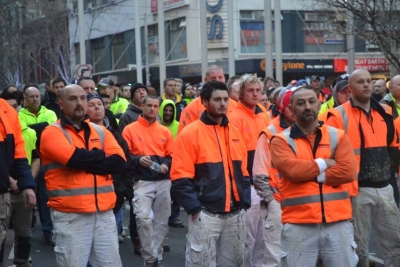
The police are prepared for a bloodbath. Row upon row of cops stand behind a temporary fence that keeps picketers well back from the giant construction site. Behind them more police, with Alsatian dogs on leashes.
Police horses gather on the corner of Swanston Street, prepared to charge on construction workers. There is no shortage of riot police to back them up. Early morning commuters parking in the QV Centre are startled by the sight of hundreds of riot police in the basement car park, banging batons on their shields as they work themselves into the frenzy required to batter unarmed human beings.
Altogether, probably over a thousand police are mobilised to smash the picket line. The ambulance service has been notified, and emergency departments are on standby for the expected casualties.
These are the scenes from central Melbourne last Friday, and repeated this morning (Tuesday). Ted Baillieu’s police force is backing-up the giant construction company Grocon in its bid to run sites without on-site union representation.
After the hysterical press campaign last week about the supposed “reign of fear” and “union thuggery” on Victoria’s construction sites, we saw clearly on Friday, and again on Tuesday, who is willing to use sickening levels of violence to enforce their will: Ted Baillieu’s police against workers standing up for their rights.
This reflects the enormously high stakes in the battle between Grocon and the main construction union, the CFMEU. The outcome of the dispute will have an impact for years to come in the construction industry.
A win for the company will mean that the biggest sites in Melbourne will proceed without any effective union presence – a massive defeat for one of the most militant and effective unions in the country. A clear win for the union will signal to the whole industry that the slow spread of shonky, non-union contractors can be brought to an end.
In fact, the implications reach far beyond that. Despite taking some hits from a series of vicious anti-union laws, the CFMEU has maintained an active presence on the vast majority of commercial construction sites in Melbourne. This puts it head and shoulder above unions in many other industries in Australia, where decades of defeat and retreat mean that full time shop stewards and active organising are a distant memory.
The capitalist press is bellowing about a return to the “bad old days” of industrial disputation in the 1970s, when workers and their unions won decent wages and conditions in a series of bruising industrial battles. This reflects a fear that the Grollo dispute will revive union fortunes not just in construction but beyond.
So it is no surprise that a conga line of right wing hacks, newspapers and employer bodies has formed, demanding blood be spilled to break the picket. The Australian Industry Group complains of “militant and unlawful” behaviour from the CFMEU, the Victorian Chamber of Commerce condemns “intimidation and harassment” from the union, while the Master Builders’ Association goes with “illegal and reckless”.
What they mean, of course, is “effective”. It is perfectly legal to join a trade union, and even to picket, so long as you aren’t effective in stopping production – one of the most serious crimes in a profit-driven society. Just last month, a NSW boss was fined just $30,000 after 15-year-old Kevin Hadfield was dragged into a metal lathe, lost his arm and then died. No front page screaming from the papers and politicians about that.
In July, Toll Holdings was hit by an effective picket line at a warehouse in Somerton, Melbourne, that it operates for the supermarket giant Coles. The company was forced to give major concessions to the union. So it is no surprise to find Toll’s chief executive Brian Kruger showing his solidarity with Daniel Grollo, calling for “more significant penalties, particularly in terms of fines or potential jail time” against picketers.
Victorian Liberal premier Ted Baillieu has called for deregistration of the CFMEU, which would stop the union from negotiating legally-binding enterprise agreements. He has talked tough, threatening to rewrite the Riot Act in order to more effectively sweep pickets out of the way. And his attorney general has sought to join the contempt of court action against the CFMEU, adding to the massive legal and financial pressure being brought to bear on the union.
Federal workplace relations minister Bill Shorten has joined this chorus, declaring that “the blockade is a terrible idea, and the mob should get off the street”, and denouncing the tactic as “industrial stupidity”. Shorten’s “smart” way is to let the union be sidelined, and he openly welcomed the fact that small numbers of scabs have crossed the picket line on Friday and again on Tuesday.


Faced with this enormously powerful list of enemies, our side has only one weapon – solidarity. This dispute is shaping up as potentially the most important industrial battle since the MUA dispute of 1998.
On that occasion, mass pickets of thousands on a daily basis kept the docks shut. The thousands of rank and file construction workers who have been calling past the Grocon picket in Lonsdale Street every morning – many answering a call from their union, others just turning up – are the basis of this kind of response.
Beyond that, serious contingents from the metals construction division of the AMWU and smaller groups from the Maritime Union, the Firefighters Union, the National Union of Workers, the Australian Services Union and many others have also appeared at the picket over the last week. Many of them are workers repaying a debt of solidarity to construction unions, who have supported innumerable disputes – from the nurses to the Coles Somerton dispute – over the years.
The Victorian Building Industry Group of unions, which includes the CFMEU, the Electrical Trades Union, the Plumbers Union and the AMWU, has endorsed a state wide strike to support the picket in the event of a serious police attack.
The CFMEU strategy since Tuesday has been to avoid a physical confrontation on the picket line. A small number of scabs, mostly managers and other non-productive employees, have been able to access the site under heavy police escort.
But as of Tuesday afternoon, there has been no production on site for two weeks. The reality is that building sites need more than labour. They need a vast amount of material delivered daily, and they need concrete delivered and pumped. To do all that requires clear access for trucks to the crane bays.
It is one thing for Victoria Police to get access for a small number of scabs. It would be an even more massive and ongoing operation for them to clear the streets and keep them clear to allow access for material – especially the continuous convoy of concrete trucks necessary to pour a slab. Even the most massive police operation will have a hard time doing this on a daily basis against determined mass pickets.
Grocon boss Daniel Grollo has reportedly taken on a mountain of debt in order to buy out other family members from the family business. For the last couple of weeks, servicing that debt has looked difficult if not impossible. He has faced disruption on a number of jobs, and pretty much the only thing moving on his landmark Lonsdale Street Myer job has been the pigeons.
However, this standoff can’t last indefinitely.
Grollo has rejected out of hand the idea that his legal action and the union’s blockade could both be lifted to allow talks. This and the extraordinary police deployment, the ferocious attacks of the press, and the open proclamation of Australia’s business elite all point in the same direction. Our rulers are prepared to deploy massive force to batter a key union into submission.
Well over a thousand construction workers have, over the last week, made it part of their daily routine to call past the picket from 5am. Thousands more have made it clear they are prepared to descend on the site at a moment’s notice if the union gives the call. Outside of construction, traditions of solidarity have awoken again – especially in blue collar workforces with a union tradition.
It is these workers in their thousands and tens of thousands who can, if called into action, stop Grollo in his tracks – and strike a vital blow in turning the tide for workers and our unions in Australia. 

Saturday, 18 August 2012

Massacre at Marikana Mine - Solidarity with Labour in South Africa!


Amandla! Ngawethu!


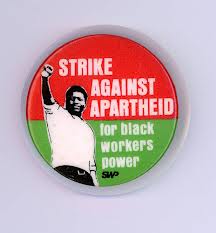
I, and most people in the anti-apartheid movement in New Zealand, took part in the boycott campaigns not to simply change the colour of the faces of those who ruled South Africa. We didn’t face batons and barbed wire to replace race-based apartheid with economic apartheid. Our intention wasn’t to stop the apartheid gravy train for the wealthy just long enough for a tiny number of the black elite to jump on.

John Minto recently made public his correspondence with the organisers of a conference happening in Wellington this weekend celebrating NZ’s role in the struggle against apartheid. How tragically immediate these words are!

Police in South Africa have massacred over 30 striking miners in the Marikana platinum mine, one of the most violent attacks on labour since the end of apartheid, and a horrific act reminiscent of the Apartheid state’s brutalities at the 1960 Sharpville massacre in the Gauteng (Transvaal).

Amandla, a radical magazine in South Africa, call this "a brutal tragedy that should never have happened," and editoralise:

No event since the end of Apartheid sums up the shallowness of the transformation in this country like the Marikana massacre. What occurred will be debated for years. It is already clear the mineworkers will be blamed for being violent. The mineworkers will be painted as savages. Yet, the fact is that heavily armed police with live ammunition brutally shot and killed over 35 mineworkers. Many more are injured. Some will die of their wounds. Another 10 workers had been killed just prior to this massacre.
This was not the action of rogue cops. This massacre was a result of decisions taken at the top of the police structures. The police had promised to respond with force and came armed with live ammunition. They behaved no better than the Apartheid police when facing the Sharpeville, 1976 Soweto uprisings and 1980s protests where many of our people were killed.
The aggressive and violent response to community service delivery protests by the police have their echo and reverberation in this massacre.
This represents a blood-stain on the new South Africa.

Media coverage has stressed the complexity of the inter-union rivalries, but the involvement of the police – and the shooting down of striking workers – makes it clear what is involved. “The Marikana action is a strike by the poor against the state and the haves, argues Justice Malala.

The old slogans from the anti-apartheid struggle have a new relevance. Once again, we say “Solidarity with South African labour!”

Amandla! Ngawethu!


***
Striking South African mineworkers were gunned down by police on Thursday. Charlie Kimber looks at events leading up to the massacre—and the business interests behind it

Police in South Africa have opened fire at striking workers at the Marikana platinum mine near Rustenburg, leaving at least 18 people dead. Ten people have died over the last few days in other clashes.

This disgusting slaughter evoked memories of how the police acted during apartheid. All the hope at the end of that vile racist regime has come to this.

The recently appointed police chief Mangwashi Victoria Phiyega visited the mine a few days ago and she is believed to have coordinated Thursday’s action.

But the decision by the heavily armed police to use live rounds must have been endorsed at the highest level—perhaps even by the ANC’s President Jacob Zuma.

Zuma said he regretted the killings. But disgracefully he made no reference to the handling of the situation by the police.

There must be justice for the strikers killed at Marikana—and those who ordered the deaths must pay for them...


[Read the full background story and analysis from Charlie Kimber at Socialist Worker]


Tuesday, 24 July 2012

The Revolution in Syria is rooted in popular uprising

by Alex Callinicos

The past few days may have seen the balance of forces tilt decisively against Bashar al-Assad and his regime. Paradoxically, a significant section of the Western left seems to have tilted as decisively in their favour.

Take, for example, a widely circulated interview with Tariq Ali, where he claims that the struggle in Syria is part of “a new process of recolonisation”. Although I have great respect and affection for Tariq, I think this is nonsense.

Undoubtedly, the invasion of Iraq in March 2003 did lead to the country’s temporary recolonisation, under a “Coalition Provisional Authority” headed by a Washington-appointed neoconservative.

But the resistance to the occupation meant this project badly rebounded on its authors. The new regime created by US military power ultimately forced it to withdraw its forces from Iraq.

The idea that Syria is being “recolonised” implies that it is a long-standing Western priority to remove the Assad regime. But there is no evidence of this. Under Bashar’s father Hafez, the Syrian state established itself as a brutal but reliable capitalist manager.

Undoubtedly the outbreak of the Syrian revolution has encouraged the regime’s regional opponents to seize on the opportunity to replace it with something more congenial.

This is particularly true of Saudi Arabia and Qatar, whose Sunni Muslim rulers dislike the Assads’ roots in what they regard as the heretical Alawi sect and Syria’s alliance with Shia Iran.

There is plenty of evidence that the Gulf states have been supplying arms to some of the forces fighting the regime. And the West has stepped in to call for Assad’s removal.

But the chances that the US and Britain will follow this up by sending troops to Syria, or even providing air cover to the rebels as they did in Libya, are remote.

Debacle

This is partly because they are scared of repeating the Iraq debacle. But it is also because of the support Russia is giving the Assad regime, its last ally in the Middle East.

Elsewhere in the interview Tariq says that the Syrian people want neither the Western-backed Syrian National Council nor the Assad regime. I think this is probably true, at least of the majority.
But where is this majority? There is considerable evidence that very large numbers of people are demonstrating against the regime, and sometimes fighting it, but don’t call for Western intervention.
In recent weeks the revolution has spread to the two biggest cities, Aleppo and Damascus. Rebel fighters have tried unsuccessfully to seize the centres of both cities.

Are Tariq and those who agree with him sure that these are all puppets of the US and the Gulf reactionaries? If so, they are being betrayed by their masters, since the regime's forces have been able to beat them back because they lack tanks and heavy weapons.

Nevertheless, the evidence is that the regime is now taking heavy casualties—and not just thanks to spectaculars such as last week’s bomb that took out several of Assad’s top cronies.

The fighting bears all the hallmarks of an improvised and desperate armed rising. We can argue over whether it was wise politically for the rebels to militarise their struggle so quickly. We may regret the absence of the independent working class action that has been so important in the Egyptian revolution.
But the way that its Syrian counterpart has so rapidly developed into a civil war doesn’t alter the fact that its roots lie in popular revolt.

One thing the Arab revolutions have revealed is that much of the left in the region is politically dead. The best evidence is provided by those elements in the Egyptian Communist Party who backed the military candidate, Ahmed Shafiq, in the recent presidential elections.

Those in the Western left who allow a reflexive and unthinking “anti-imperialism” to set them against the Syrian revolution are simply confessing their own bankruptcy.

[This article first appeared in Socialist Worker UK]

Tuesday, 26 June 2012

Egypt: Do Not Leave the Squares Before We Win


ONCE MORE, the citizens have proven that they are still capable of aborting the plots of the military and the forces of counterrevolution. They have proven that revolutionary legitimacy is capable of seizing the deserved benefits of our democratic and social revolution.

Here we see the plans of the military council fall back before our eyes--even if only temporarily--beneath the pressure of the citizens and their steadfastness in the squares. We see the terror of the generals at the possibility that this revolutionary wave would transform into a flood that their rule could not withstand. We should be optimistic today, as our revolution has achieved an important victory along the way by defeating Shafiq, but there are still fateful challenges before us.

With the success of millions of Egyptians in frustrating the plans for the progression of the military's fascist candidate, despite the massive fraud and violations that were practiced to his benefit, we stand today with the military coup hanging as the sword of Damocles over our heads, hanging over the revolutionary forces confronting it with the utmost solidity and firmness. From here on, we place great value on the many efforts and initiatives that have been put forth during the past days, striving to build a front unifying the revolutionary ranks to end military rule.

There still remain in the pockets of the military many traps and tricks. Given our previous experience, many doubts still surround the promises of the Muslim Brotherhood to continue with their sit-in after the success of their candidate until all demands have been achieved.

It is incumbent upon the Brotherhood youth today not to permit the repetition of the leadership's mistakes leading to their abstention, bringing our revolution to this point a second time. Perhaps the military's boasting the dissolution of parliament was a decision they took long ago and only now took "out of the desk drawer" reveals the frailty of any ruler as long as Mubarak's generals rule from behind the curtain.
The recent days and weeks have removed many masks, revealing the truth about numerous proclaimers of revolution who, when their interests were at stake, threw themselves into the embrace of the military without hesitation.

For this reason, the coming weeks will be a discriminating sorting process for the political forces still present in the field, based on the degree of persistence in their positions and determination to satisfy the aspirations of the masses. The people will have no mercy on the Brothers or any others if they return to negotiations behind closed doors with the military yet again.

We call upon all revolutionary forces to align in opposition to the military's plans, to join immediately those stationed in the squares and to stand firm until the implementation of the following demands:
-- 1) An end to the constitutional decree addendum, and the immediate surrender of power by the army.
-- 2) Mohamed Morsi must announce his refusal to take the oath before the Supreme Constitutional Council.
-- 3) Cancellation of the law permitting military arrests of civilians, and the cancellation of the National Defense Council.
-- 4) The issuing of a presidential decision granting immediate amnesty for all political prisoners, and the rescinding of all military rulings pronounced against civilians since the beginning of the revolution.
-- 5) A popular referendum on the dissolution of parliament.
-- 6) The complete purging of all state institutions that have been militarized over the past months.
-- 7) Stabilization of prices, an end to privatization, nationalization of the monopolies and the return of the companies for which the sales contracts have been overturned by the courts.
Finally, we affirm that the organized pressure of the masses is the only way to achieve the goals of our revolution. The revolutionary front has become an indispensable necessity, provided that it is founded upon real roots, that it adopts the social and political demands of the people, organizes them, and supports the struggle to attain those goals.

This is the way toward the victory of the revolution.

Down with the military coup!
Our revolution continues!
Power and wealth to the people!


***


This statement from the Egyptian Revolutionary Socialists was first published at Socialist Worker US

Wednesday, 20 June 2012

Egypt: Unity against the Generals' Attempted Coup


by Mostafa Bassiouny, Revolutionary Socialists, Egypt


The ruling Military Council (Scaf) has launched a number of very serious attacks on the Egyptian Revolution over the last week. The military police can now arrest civilians at will and parliament has been dissolved.
The generals have also announced additions to the Constitutional Declaration of March 2011 which give them virtually unlimited powers.

We have to understand that this military coup has been in the making for a long time. What happened during the last week was the culmination of a process that had been going on for months.

The problem became visible with the reaction to the sentencing of former dictator Hosni Mubarak on 2 June. The protests were not strong enough—they were much smaller than before.

The mass movement had retreated. So Scaf believed it could act without facing a strong reaction. The generals’ growing confidence led them to think they could take on the Muslim Brotherhood.

For most of the last year the Brotherhood has worked closely with Scaf, but now it is under attack.
The last round of the presidential election pitted Mohamed Mursi of the Brotherhood against the generals’ candidate, Ahmad Shafiq. We don’t have official results yet, but Mursi appears to have won.

We don’t equate Mursi and Shafiq. The Egyptian Revolution was a popular revolution, which involves a broad spectrum of forces from the right to the far left.

Right
The Muslim Brotherhood represents the right wing of the revolution. It is not the counter-revolution.
It saw the fall of Mubarak as an opportunity to work with Scaf so the Muslim Brotherhood could take a role in government.

So since 11 February 2011 the Brotherhood has been a conservative organisation. But Shafiq is the counter-revolution.

That is why we are mobilising for protests against the military coup alongside the Brotherhood. Most political forces are taking part.

We are calling on revolutionary forces to build a mass movement against the coup and the changes to the Constitutional Declaration.

However we believe that the role of the workers’ movement will be critical in the coming months.
Workers’ demands for social justice remain unmet, and whichever candidate becomes president will have neither the desire nor the means to meet them.

Socialists have a crucial role to play in helping build up workers’ organisations which can confront Mubarak’s regime and get rid of capitalism itself.

(This was first published at Socialist Worker UK Photo credit: Gigi Ibrahim)

Tuesday, 19 June 2012

SYRIZA's Struggle Continues


Lee Sustar reports on elections in Greece--and the extraordinary challenge against austerity policies mounted by the Coalition of the Radical Left.
AN ALL-out fear campaign by Greek and European capitalists helped conservatives eke out an election victory over the surging Coalition of the Radical Left, known as SYRIZA by its initials in Greek.
Bankers and establishment politicians across Europe celebrated the fact that SYRIZA's principled anti-austerity program wouldn't become Greek government policy. As the Financial Times noted: "In spite of SYRIZA's strong performance, European governments were sure to be relieved that a party dedicated to overturning the terms of Greece's international financial rescue appeared to have fallen short of victory."
The European ruling class feared that a SYRIZA-led government coalition, while pledging to keep the euro as Greece's currency, would be forced to leave the common currency shared by 17 countries if it refused to abide by the so-called "Memorandum"--the agreement that obliged Greece to make sweeping cutbacks in government spending, wage cuts and higher taxes in exchange for a bailout by the European Union, European Central Bank and International Monetary Fund.
It was growing anger over these austerity policies that propelled SYRIZA from the margins of Greek politics to a second-place finish in the inconclusive May 6 elections. Then, the party got 16.78 percent of the vote. This time, despite an all-out effort by the mainstream media and politicians to undermine SYRIZA, the party scored 26.89 percent, only a few percentage points behind the leaders, the conservative New Democracy party.
Moreover, SYRIZA obtained twice as many votes as the center-left PASOK party, one of the two main parties in Greek politics for four decades, which has been discredited by its central role in implementing austerity policies since 2009--first as the governing party, then as the senior partner in a coalition government of "technocrats."
By tapping into the popular fury against austerity that has led to 17 general strikes and countless protests, SYRIZA upended Greek politics. Now, with an expected 72 members in the Greek parliament, it is well placed to build further resistance.
"This was a great result, even though we weren't able to defeat New Democracy," said Antonis Davanellos, a member of the socialist group Internationalist Workers Left, a cofounder of the SYRIZA coalition in 2004. "It was better than we could have hoped for before these elections began. We are out of the discussion of creating a government, but we are in a position to help lead the serious fight against the memorandum and austerity."
The radical left could have emerged as the dominant electoral player if the Greek Communist Party (KKE, according to its initials in Greek) had blocked with SYRIZA in an electoral alliance. But the KKE is an old-school Stalinist party with a sectarian refusal to collaborate with other left-wing groups.
The political polarization in Greece hasn't only benefited the left. The Nazi Golden Dawn party scored nearly 6.92 percent of the vote, enough to gain 18 seats in parliament. Golden Dawn, an openly pro-Hitler party, made a name for itself by physically attacking immigrants and blaming them for Greece's crisis. Its rise is ominous--and underscores the importance of both confronting the right and building a left-wing alternative to attract those who are deserting the main parties.
- - - - - - - - - - - - - - - -
WORRISOME AS the rise of Golden Dawn may be, the left clearly has the momentum in Greece right now. The pressure from SYRIZA forced New Democracy leader Antonis Samaras to make promises that he almost certainly can't keep.
To reassure Germany--the dominant power in the eurozone and its debt collector--Samaras told international audiences that if he were elected, Greece would make good on more austerity measures that are required as a condition of getting bailout loans. But in his election speeches, Samaras suggested that he'd be able to renegotiate the Memorandum to gain relief for Greek workers.
Samaras said that he wants "to add to our commitments the necessary policies for growth and to combat unemployment," and wants to seek a longer time in which to make the fiscal adjustment--that is, budget cuts and tax increases--demanded by creditors.
But while the next round of cuts may come more slowly, they will come--and with devastating effect, if Samaras has his way.
To understand why Greece's political turmoil will continue, look at the numbers: 48 percent of Greeks live at or below the poverty level, following a 30 percent drop in wages. Unemployment stands at around 22 percent--and is far higher among youth. The expected coalition government of New Democracy and PASOK will pursue policies that will only worsen those numbers--and spark new protests and resistance.
The challenge now for SYRIZA is to transform its electoral appeal into a political vehicle that the mass movement can embrace and make its own. SYRIZA's leader Alexis Tsipras pledged to keep up the fight: "Overthrowing the bailout is the only viable solution. From Monday [after the election], we will resume the struggle against it."
There will be no shortage of opportunities for struggle. Even if the dominant European Union (EU) powers give Greece some breathing room in the short run, they intend to keep squeezing, as the Financial Times reported:
Publicly, EU leaders have studiously avoided comment on their plans. Just by acknowledging that they may be willing to rework the bailout, they feared that they would validate Mr. Tsipras' argument, and boost his standing.
Yet behind the scenes, they have been busy debating a package of concessions to dangle before a new Greek government. The catch is that the government would have to recommit to the main outlines of the bailout.
Some of the benefits on offer could include lower interest rates and extended maturities on the loans, but not changes or extensions to the fiscal targets, according to senior officials in Brussels and Berlin.
If negotiations bog down, the EU may squeeze Greece. Member states withheld 1 billion euros [$1.2 billion] from a loan disbursement last month, pending the outcome of the elections. Without such funds, Greece will not be able to pay salaries and pensions--let alone bond redemptions.
- - - - - - - - - - - - - - - -
A SYRIZA government would have challenged this "bailout," which, after all, is aimed only at funneling money through Greece's accounts and back out to the European banks that hold Greek government bonds. That's why European capital went all-out to prop up Samaras and New Democracy.
But if the mood of European financiers and politicians was brightened by New Democracy's win in Greece, the eurozone remains mired in crisis. Government finances in Spain are unraveling after the $125 billion bailout of Spanish banks only added more debt to the government's books and raised the specter of more Greek-style austerity in that country.
That's why SYRIZA's election result looms so large. By showing that it's possible to mount a political appeal against austerity, SYRIZA can emerge as a reference point for Europe's left, labor unions and social movements, which face their own struggles in the weeks and months ahead.
And the struggle in Greece will continue. Capital has made it clear that the austerity agenda will continue unless and until working people are organized enough to stop it. SYRIZA's rise highlights the potential to do just that.

(This article was first published at Socialist Worker US)

Tuesday, 15 May 2012

The Politics of the Rising European Left


by Alex Callinicos [from Socialist Worker UK]


Europe's political leadership is bankrupt. This is true literally, as we can see with the latest stage of the banking crisis unfolding in Spain. If the eurozone continues to unravel, there simply won’t be enough money to save it.

It is also true morally and intellectually. And everyone knows it. This is the main lesson of the recent elections.

The pattern is clear. The centre—which stands for the austerity policies that Angela Merkel is determined to hardwire into the institutional structure of the European Union—is being squeezed. And there is polarisation further to the right and to the left.

The advances the extreme right are making are very frightening. Chrysi Avgi (Golden Dawn), which won seven percent of the vote in the Greek elections, aren’t Euro-fascists in suits. They are hard, street-fighting Nazis.

But it’s the growth of the radical left on which I want to focus. The clearest case is of course Syriza, the Coalition of the Radical Left in Greece, which got 16.8 percent of the vote in the elections ten days ago. Polls suggest that it might win 25 percent or more if there is a re-run in June.


To this we have to add Jean-Luc Mélenchon of the Left Front, who polled 11.01 percent in the first round of the French presidential elections last month. And there are other cases.

The Dutch government collapsed recently under the weight of the austerity policies it had helped Brussels impose. It was the right-wing populist Geert Wilders who pulled the rug from under the ruling coalition, but the radical-left Socialist Party is top of the polls.

What is the politics of this rising left? Over-simplifying a little, it is essentially some version or other of left reformism. It’s true that Syriza includes within its ranks an assortment of far-left groups, but the dominant force, Synaspismos, originates in the more accommodating and pro-European wing of the Greek Communist movement.

Breakaway


Mélenchon led a left-wing breakaway from the French Socialist Party after serving as a minister in the disastrous Plural Left government that held office in 1997–2002. The most powerful organised force within the Left Front is the French Communist Party(CP) which for decades has hung onto the coat tails of the Socialist Party.

A marked feature of the French presidential elections was the poor performance of the revolutionary left. Olivier Besancenot ran ahead of the CP in 2002 and 2007. But this time the candidates of both his New Anticapitalist Party and of Lutte Ouvrière, which in the days when Arlette Laguiller ran for it had a high profile, were eclipsed by Mélenchon.

It’s not surprising that left reformist parties are making the running against austerity. They are filling a space left by the rightward shift of mainstream social democracy. Parties like Labour and the French Socialists are now called “social liberal” because of their embrace of neoliberalism.

Figures such as Mélenchon, the Syriza leader Alex Tsipras, and, in this country [Britain], George Galloway are able to reach out to traditional social-democratic voters by articulating their anger in a familiar reformist language. Ed Miliband and François Hollande are trying to recalibrate their parties’ messages to relate to this anger, but their unwillingness to break with social liberalism leaves a big space to their left.

In any case, whether it is mainstream social democrats or their more radical challengers who are able to ride to office thanks to the rebellion against austerity, they will come under enormous pressure to accommodate with the German government and the financial markets.

After the Greek elections, Tsipras made an excellent statement demanding an end to the “barbarous” austerity programme. But then he wrote a much less confrontational letter to the presidents of the European Council and the European Parliament.

This kind of ambiguity is inherent in any version of reformism, which seeks simultaneously to express workers’ resistance to capitalism and to contain it within the framework of the system. But it underlines the necessity of building a revolutionary left that is part of this great movement sweeping Europe but maintains its own political identity.

[For more on the struggle in Greece, read "We Will Defy the Bankers: Greek Workers Speak Out", "Workers in Greece say No to Parties of Austerity", and "Greek Golden Dawn Nazis: a Warning from History"]