Showing posts with label Our History. Show all posts

Tuesday, 9 October 2012

Review: The Significance of the 1912 Waihi Strike


Review: The Significance of the 1912 Waihi Strike
Martin Gregory
International Socialist Organisation, 2012
ISBN: 978-0-473-22214-7
$5

Reviewed by Andrew Cooper


On Monday a force of thugs and scabs attacked the union hall under the gaze of the police with a hail of missiles. A plug of gelignite was thrown, exploding just outside the hall entrance. The windows were smashed. The attackers broke in to besiege a group of unionists in the committee room. After a while the police called the violence off and the unionists made their escape, only one being caught and beaten up. On Black Tuesday… the police and scabs attacked. The unionists were not able to bolt the door in time. There were gun shots as thugs and police broke in and the unionists fled through the back way. The scabs and a notorious thug fell upon the stricken union man (pp. 33-4).

These events didn’t happen in some far-off country but in the small town of Waihi one hundred years ago. The victim was Frederick Evans. His death was the first of a New Zealand worker on the picket line (and the only one until Christine Clarke was killed in 1999).

In this lively pamphlet, Martin Gregory provides not only a fascinating description of this pivotal event in NZ radical history, but crucially draws out its key political lesson:

The defeat of the goldfield strike initiated a turning point of such immense political significance that its effects echoed for decades after. The lessons to be drawn from the strike are profound and are still vitally relevant to the working class movement today… Setbacks are an unavoidable part of the working class’s experience, and there is no escaping the fact that Waihi was a crushing defeat. The significance of the Waihi Strike lies in the conclusions that were drawn from the intervention of the state. They were to greatly affect the future course of working class organisation and the history of New Zealand. The strike marks a real turning point (pp. 4, 35).

In 1894 the Liberal Party Government had passed the Arbitration Act, giving registered unions official recognition but also binding them to the Arbitration Court’s decisions as well as forcing workers to fight employers in the courts where the employers and state were at their strongest. Strikes were outlawed.

Arbitration was initially popular with workers as it led to improvements in pay and conditions, but inevitably over the long term it favoured employers. The first serious challenge to Arbitration came with the successful Blackball minersstrike in 1908, leading to the formation of the Federation of Mineworkers, the forerunner of the “Red” Federation of Labour or FOL.

The Waihi miners worked under a competitive contract system that set miner against fellow miner. It was said that a miner had a useful working life of about fifteen years - but it was a hugely profitable life for the mine owners.

In early 1911, the powerful Waihi Workers’ Union (WWU) achieved the absolute majority it needed to escape Compulsory Arbitration by cancelling its registration under the system. As a direct result the miners’ working conditions greatly improved - but these gains could all be lost if a rival union was registered under the Arbitration system: If just fifteen members could be found it would become the officially recognised union - and the Arbitration Court’s decisions would be binding on all 1,200 Waihi miners. On May 11, 1912, the mining companies succeeded in doing just that. The following day the WWU executive made the momentous decision to send an ultimatum to the mining companies demanding that they disband the new union.

Many of the miners’ leaders were influenced by “syndicalist“ ideas, particularly those of the American Industrial Workers of the World (the IWW or “Wobblies”). Syndicalism emphasised the key role of the strike and a “whole class” outlook as opposed to that of the narrower craft unions.

The FOL was closely linked to the supposedly revolutionary NZ Socialist Party. As Martin correctly points out in his pamphlet, understanding the politics of this organisation is key to understanding the politics and tactics of the strike itself - and its outcome.

The party was split into several political currents, expressing a range of both revolutionary and reformist positions - though in practice it was the parliamentary arena to which the Socialist Party’s leaders devoted most attention. This factionalism led to increasing dissatisfaction within the party, with some leaving to join the Wobblies. Although the Socialist Party’s leaders espoused revolutionary socialist positions, in practice they avoided strikes where possible, seeing them as a threat to the party’s growth. During 1912 the party was unable to offer revolutionary leadership and its members would instead look to the IWW for leadership and ideas.


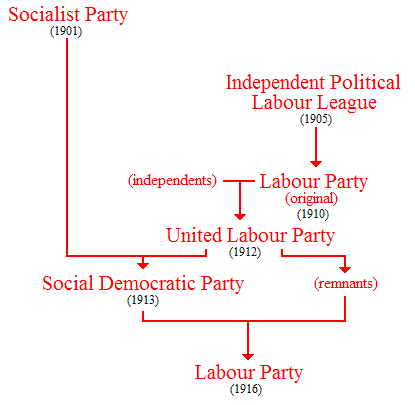
Along with the NZ Socialist Party there was also the United Labour Party, constituting the formally more moderate wing of the labour movement at the time.

Meanwhile the Federation of Labour leadership equivocated in its support for the Waihi miners. After they failed in negotiations with the mining companies, pressure from members led to a new constitution modelled on the IWW’s being adopted: “including the rhetorical gesture that was the splendid revolutionary syndicalist IWW preamble“ (p. 23).

With the militants’ call for a general strike defeated and the leadership majority’s position essentially one of inaction, the Federation merely agreed to a 10% weekly levy on members’ wages to support the strikers:

Both the majority position of inaction and the IWW fetishist demand for an immediate general strike were faulty. The working class is not a stage army. A general strike cannot be conjured up without a broad-based head of steam for action. The call for an immediate general strike from the Federation conference was unrealistic even for Federation unions, let alone the unaffiliated (p. 24).

The Federation had missed an opportunity to broaden the strike beginning with other mine workers, and while the mining companies had no intention of letting legal niceties get in the way of defeating the miners, there was uneven support for the mine workers, with the “moderate” ULP actively opposing the strike and even helping to organise scab labour. As Socialist Party member and future Labour leader Harry Holland put it: “Thus the Federation of Labour was fighting directly the Gold-mine Owners’ Association and the Employers’ Federation, and secondly the scabs, the press, ruling class law and its Massey Government, and the United Labour Party” (p. 27).

Between the strike’s beginning in May 1912 and August that year, attempts to alternately starve then divide the workers had failed. In August the companies began recruiting strikebreakers and the following month police stepped up confrontation with the miners. Strikers were jailed, gaining more widespread working class support. A scab union was formed with the intention of forcibly reopening the mine. The editor of the United Labour Party’s newspaper went to Waihi to help organise the scab union.

On the back foot, the Federation of Labour called a general strike in October. It failed to win support beyond the miners due to the FOL’s inept handling of earlier disputes. By early November there were over a hundred strikebreakers working the Waihi mines, and police violence against the strikers increased. The author gives a vivid account of the events of Black Tuesday and their aftermath. Nine thousand would attend Evans’ funeral in Auckland.


Strike leaders were run out of town. The strike was now effectively over, though not officially called off until the end of November. By the end of the year the competitive contract system was reinstated.

Violence against the strikers and the government’s failure to hold an official inquiry caused outrage amongst the working class. Much of the ULP membership shifted to the left, repudiating strikebreaking. However the main lesson drawn by the Federation of Labour’s executive was that the government had to be fought politically (i.e. through elections) rather than by direct action.

The events of 1912 and the following year’s Great Strike would ruthlessly expose the IWW’s weaknesses too. Its “fetishisation” of the general strike ignored the role of the capitalist state: the idea that industrial action alone could force parliament to enact reforms ignored the fact that the ruling class could also use force in the form of its army and police forces:

The real tragedy of the Waihi Strike is that a generation of revolutionary socialists rebounded from the industrial defeat to retreat into reformism. The significance of the eclipse of the Socialist Party is incalculable for what might have been. What is certain is that reformist politics was strengthened immensely by the liquidation of its revolutionary rival. Reformism gained a cohort of activists with enormous authority within the working class and the standing of the leftist leaders would grow. These and other former revolutionaries became leaders of the Labour Party. Compared to today’s Labour careerists they were giants, but they became shadows of their former revolutionary selves, Red Feds, once feared by the capitalist class (pp. 43-4).

The reformists’ fear of “scaring off” supporters by being “too militant”, and their focus on parliamentary elections rather than direct struggle will no doubt sound familiar to any activist today. The negative lessons drawn by reformist union and political leaders - that workers couldn’t win against the superior repressive powers of the state and its police force, that militancy would scare away most workers and supporters, and most of all that elections and parliament are the most effective arenas to bring about change - had a disastrous impact on the subsequent development of NZ radical politics.

What might have been had subsequent struggles been led by a workers’ organisation with clear revolutionary politics? What if the Stalinist leadership of the CTU (who gave up the struggle against the Employment Contracts Act before it had begun) had been seriously challenged from below in 1991?

Or if the struggles around university fees and the loans scheme during the 1990s had been led by activists with revolutionary politics rather than career-minded reformist student officials (who for most of that decade told us to put our faith in university management and vote for an “education-friendly” government).

Much the same criticism could be made about reformist leadership in dozens of other struggles over the last century.

This pamphlet is precisely what we need: more in-depth analyses of our hidden radical history, more writing on current politics from the International Socialist perspective. As well as producing work like this, we should be encouraging student members and supporters to think about writing their theses on similar topics.

On the centenary of the Waihi strike, this pamphlet ensures that our working class history is a little less “hidden from history”. But unfortunately as so much of NZ’s radical past is hidden from history, readers lacking a detailed knowledge of this period are likely to struggle a little with the plethora of acronyms: IWW, NZSP, FOL, ULP, WWU, SDP, UFL, etc. A helpful addition to this pamphlet might have been a glossary of these acronyms along with a brief description of their respective organisations.

Martin provides a useful list of further reading at the end of the pamphlet, and rightly singles out Harry Holland’s The Tragic Story of the Waihi Strike as the key early resource. First published in 1913, it is now in the public domain and is available in several free electronic versions, including PDF, epub and Kindle (here and here) along with at least two new print editions.


How to purchase

If you’d like to order this pamphlet send a cheque for $5 per copy made out to “ISO Wellington” to:
PO Box 6157
Dunedin North
Dunedin 9059

Please make sure you include your address.

Alternatively you can make a direct credit payment to our BNZ bank account: 02-0536-0456903-00, then email us: internationalsocialistsnz [at] gmail.com -  to confirm payment and your address details.


Image Credits

Rogers, R fl 1912. Miners outside their union hall, during the Waihi strike. Nash, Walter :Postcards associated with Walter Nash. Ref: PAColl-5792-05. Alexander Turnbull Library, Wellington, New Zealand. http://beta.natlib.govt.nz/records/22583647

Waihi Arts Centre and Museum. Striking Waihi miners leaving the union hall after a mass meeting. Waihi Arts Centre : Photographs and lantern slides of Waihi. Ref: 1/2-116691-F. Alexander Turnbull Library, Wellington, New Zealand. http://beta.natlib.govt.nz/records/22832745

Thursday, 20 September 2012

The Significance of the 1912 Waihi Strike 1912 - 2012


This year marks the centenary of the 1912 Waihi miners' strike, one of the most important - and violently contested - strikes in New Zealand history. Frederick Evans was matyred; political ideas and organisational questions clarified; and the role and force of the state made clear. The strike offers many lessons for today.

To mark the occasion, we have published a new pamphlet, The Significance of the 1912 Waihi Strike. This pamphlet aims to introduce the story of the strike to a new generation of unionists and activists, and to draw out its political significance.

You can order copies for $5 by emailing (internationalsocialistsnz [at] gmail.com) or by writing to ISO, PO Box 6157, Dunedin.

Pamphlet Launch

We will launch the pamphlet on Tuesday 25th September at 6pm in the Student Union Building, Victoria University Wellington. The author, Martin Gregory, will speak on the significance of the Waihi Strike and there will copies available to purchase.


The Significance of the Waihi Strike
by Martin Gregory
International Socialist Organisation
(ISBN 978-0-473-22214-7)

Sunday, 12 August 2012

Honouring Past Struggles: Whangamata Protest 2008

In July 2008, Hauraki Māori and other community members of Whangamata occupied the proposed car park area of the Whangamata marina. What led them to this point?

Te Matatuhi (the marina site) is the ancestral name of tangata whenua for the specific lands subject to the proposed marina. Te Matatuhi is land of particular significance to Ngāti Whānaunga. ‘Mata’ in both Whangamata and Matatuhi refers to the black volcanic rock obsidian. Mata has long been a principle reason for why Maori live in Whangamata, as the rock was widely sought after for its fine cutting edge. The harbour facilitated trade and many battles were fought in the area.
Various Pākehā business figures had eyed up the Te Matatuhi as a place to build a marina from the mid-twentieth century, but it wasn’t until 1992 that the Whangamata Marina Society was formed and approved the district council to buy the land. In 1996 hearings began on the Whangamata Marina Proposal. Te Rūnanga a Iwi o Ngāti Tamaterā, Ngāti Whānaunga, Te Kupenga o Ngāti Hako, the Whangamata Maori Komiti and other iwi groups consistent in their opposition to the marina proposal from the start and made many submissions and appeals.

The reasons for the iwi groups’ opposition to the marina were extensive, and included the following concerns: that the marina would destroy traditional fishing grounds due to significant and ongoing dredging of the channel where their kaimoana grounds are, a lack of respect of the ancestral ties to Moanaanuanu Estuary and Whangamata Harbour, destruction of wetlands which are important to bird life and the endangered moko skink, and removal of public access to the beach.

The next milestone of the marina was March 2006, when the then Minister of Conservation refused consent. His decision was judicially reviewed by the marina developers and sent back to him, then passed on to the then Environment Minister in the interests of transparency. He allowed the marina to go ahead in December 2006 provided that strict conditions were met regarding containment of dredged materials during construction and monitoring of the world famous surf break at the estuary's entrance. In the first half of 2008, there were several changes to the proposal.
Approximately 30 Hauraki Maori and community members occupied the proposed car park area of the marina for 18 days in July 2008 until they received assurance from Environment Minister Trevor Mallard that he would review the consent process. One of the reasons they felt occupation as necessary was to raise awareness about the changes to the marina development over recent months that the community had not been privy to because they were all processed on a non-notified basis. Spokesperson Nathan Kennedy [Ngāti Whānaunga] was quoted as asking, “what happened to access for all under the Foreshore and Seabed legislation?”
When the marina was built, Waitangi Tribunal Claim Wai 262 had not yet been completed. This is a wide-ranging claim about the management, use, and commercialisation of indigenous flora and fauna, and thus may have had impact on what happened in Whangamata.
Sadly, the outcome of the occupation was that in September of 2008 the marina society began construction without all obligations being met. Several rare species were displaced or exterminated for the development, including the rare Oligosoma moco skink. The marina opened in November 2009.

Juliet Thomberson

Friday, 25 May 2012

Book Review: The Lacuna


How do you write a history of revolutionary lives and activity in the mid 20th century and sell it to the public? A tough order, certainly, but Barbara Kingsolver nails it with The Lacuna

The book follows the life of a young man, Harrison Shephard, who finds himself living between the worlds of his Mexican mother and American father. He attends high school in New York during the great depression and the Bonus Army riots, and describes the desperation and anger which filled the streets during those days. He returns to Mexico to serve in the home of Mexico’s most famous artists and communists – Diego Rivera and Frieda Kahlo. Eventually, the household grows to include those homeless revolutionaries-in-exile, Natalia Sedova & Lev Bronstein -  better known as Leon Trotsky. Following a split in the relationship between host and hosted, he serves for several years as one of Trotsky’s secretaries and finally, he finds himself living back in the country of his birth, the USA, where he has to live with his communist past, as well as a few “dirty little secrets” of his own, in the deep dark days of McCarthyism.

Though the person of Harrison Shephard is fictional, the people and social scene was real and is described in incredibly thoroughly researched detail. I cannot conceive of a more accessible account of Trotsky’s life in Mexico. Kingsolver does a fantastic job of describing his attitudes to the various struggles which occur during the years of the book, his relationship with Diego, Natalia and especially Frieda, and ultimately, his murder at the hands of a Stalinist agent.

Binding the whole story together is Harrison's understated but touching narration, and that of his eventual assistant. This medium presents the principle players in a sympathetic light, and brings out a touch of the people behind the legends. It also provides an interesting insight into small town life in the US after the second world war.
All in all, this book is an absolute masterpiece. For people interested in a picture of the lives of some of the key revolutionary players in the Americas in the pre-war period, you’d be hard pressed to find better. Alternately gripping and touching, a must read for all.

Kevin Hodder

Saturday, 12 May 2012

Remembering Our History: Centenary of the Commencement of the Waihi Strike


Today is the centenary of the start of the Waihi Strike, an occasion to commemorate one of the most epic struggles of men and women in the history of the working class. On the centenary of Black Tuesday in November we will remember loyal union member Frederick Evans [pictured above], battered to death by a squad of hired thugs and police as they stormed the Waihi miners’ union hall.

On Monday 13th May 1912 a union mass meeting in Waihi voted to send the mining companies a message the next day:

‘members of the Waihi Workers’ Union employed in the mines have ceased work, and will not resume until such time as the Union receives an assurance from the Companies that the disbandment of the recently formed Engine Drivers’ Union is insisted upon by them, and also until all engine-drivers and firemen employed on the field, other than members of the Amalgamated Society of Engineers, become members of this Union. If the Unions demands are not granted before 12 o’clock today all members of the union employed in batteries etc shall cease work.’

The goldfields strike lasted six months, ending in defeat after mass jailings and violence against the miners and their families. New Zealand was changed forever. Down went the dream of revolutionary syndicalism that socialism could be attained through industrial action alone. Politics counted after all. The Union had been confronted by the power of the capitalist state.

‘What does this power mainly consist of? It consists of special bodies of armed men which have prisons, etc., at their command.’ (Lenin, State and Revolution, 1917)

After Waihi, and further state violence and union defeats in 1913, the pendulum in the working class movement swung from industrial to political action. The Labour Party would be founded in 1916, and in 1935 the erstwhile revolutionaries who had thrown themselves into the Waihi struggle would be forming the government.


[Strikers and their supporters marching. The caption reads "who said 600?", challenging a number given in the Herald]

But this is running ahead. A little background information is needed to explain why the Waihi miners struck against, apparently, the existence of another union. It must be said straightaway that this engine drivers union was nothing but a scab union instigated by the Waihi Goldmining Company as a stratagem to defeat the Waihi Miners’ and Workers’ Union, which by 1912 had become a powerful threat to profits.

It had not always been so. Under the competitive contract system at Waihi miner was set against miner. Contractor miners bid against each other for work. The system meant that contractors had to drive their hired men hard. The work rate was breakneck, exhausting and dangerous, often times fatally. But the system was splendidly profitable. In 1906 the Waihi Goldmining Company paid out a bonanza of 75% on each share.

In 1907 the Waihi miners’ union had been to the Arbitration Court in an attempt to get the competitive contract system abolished, but Justice Sim ruled in the employers’ favour. The compulsory arbitration system was brought in by the Liberal government in 1894. The chief purpose of the Industrial Conciliation and Arbitration Act was to prevent strikes, but it also gave unions recognition and legal protection. The law bound the unions to Court decisions on terms and condition, or ‘awards’, and outlawed strikes.

The first workers to break out of this stranglehold were coal miners on the West Coast. In 1908 the Blackball miners took their case for increasing their meal break from 15 to 30 minutes to the Arbitration Court but could not get satisfaction from Justice Sim. The miners defied the Court and struck. The mine company conceded and the unionists were fined by the Court, but refused to pay. The Blackball victory was midwife to miners’ unions uniting in a Federation of Miners which declared for “The World’s Wealth for the World’s Workers.”

[Strikers jeer scabs being taken in. Note the presence of women in the protests, active in the struggle]


At Waihi successive presidents of the miners’ union found that they could not get regular employment with the mining companies and were forced to move away for work. When Bill Parry was elected in president in 1909 the union overcame the problem of victimisation by making the presidency a salaried position and a Workmen’s Inspector of Mines, as it was legally entitled to do. Parry immediately set about closing stopes until they were timbered and made safe.

The Waihi miners’ joined the miners’ federation in 1909 in which year the organisation was renamed to the Federation of Labour. The Federation grew to include labourers, tramwaymen, watersiders, shearers and flaxmillers. By its 1912 conference it had acquired the Maoriland Worker newspaper, and had 15,000 members. The leaders of the ‘Red Feds’ were members of the revolutionary Socialist Party, but the ideas that came to the fore were the syndicalist ideas of Industrial Unionism, as influenced by people such as British revolutionary socialist Tom Mann and by the Industrial Workers of the World. At the 1912 conference the following magnificent preamble to the rules was adopted:

The working-class and the employing-class have nothing in common. There can be no peace so long as hunger and want are found among millions of working-people, and the few, who make up the employing-class, have all the good things of life.

Between these two classes a struggle must go on until the workers of the world organise as a class, take possession of the earth and the machinery of production, and abolish the wages system.

We find that the centreing of the management of industries into fewer and fewer hands makes the trades unions unable to cope with the ever-growing power of the employing-class. The trade unions foster a state of affairs which allows one set of workers to be pitted against another set of workers in the same industry, thereby helping to defeat one another in wage-wars.

These conditions can be changed and the interest of the working-class upheld only by an organisation formed in such a way that all its members in any one industry, or in all industries, if necessary, cease work whenever a strike or lock-out is on in any department thereof, thus making an injury to one an injury to all.

Instead of the conservative motto: “A fair day’s wages for a fair day’s work,” our watchword is “Abolition of the wages-system.”

It is the historic mission of the working-class to do away with capitalism. The army of production must be organised, not only for everyday struggle with capitalists, but also to carry on production when capitalism has been overthrown. By organising industrially we are forming the structure of the new society within the shell of the old.

The way out of the compulsory arbitration bind was for unions to cancel their registration under the Act. The Waihi union leadership pursued this aim and twice got a majority for cancellation in 1910.  But these votes did not satisfy the registrar as they were not absolute majorities due to non-attendance at meetings. On the third ballot, this time taken at the mine entrance, the required majority was achieved and de-registration was gazetted in May 1911.

Free at last and relying on their own strength and the support of the Federation of Labour, the Waihi miners won in June 1911: a change from the competitive contract to a co-operative contract system, better pay rates, and a right to renegotiate in a year’s time. The level of control exercised by the union was such that it effectively controlled the price of co-operative contracts, in which all in the party shared equally.

It was decided that if a party could not make a satisfactory wage under the price contracted for, the members of the said party would ask the employers for a rise in price. Failing an agreement on such a basis, the Union would fix a price calculated to produce a living wage, and no unionist would take the job for less than the Union price. This rule was strictly and loyally adhered to by the men. One job was held up for four or five months, although the company offered within one-halfpenny per ton of the Union price. (Holland et al, The Tragic Story of the Waihi Strike, 1913)

Never had the Waihi miners had it as good and never had attendance at union meeting been as great. All was put at risk by an arbitrationist union being recognised. All it took for registration under the Act was for a union to have 15 members and there being no other registered union. The registered union would be the official union and the awards of the Arbitration Court would be binding on all workers in that industry or place no matter how unrepresentative the union.

The employers had used this ruse before, in Auckland. They set about it in Waihi amongst the engine drivers and firemen. A hand-picked minority were selected to attend a meeting, but only 13 attended. At a second meeting, on 11th May 1912, a qualifying 25-30 engine-drivers and firemen were cobbled together to form the arbitrationist union. The scene was set for the inevitable clash.

Martin Gregory


Monday, 30 April 2012

May Day: International Workers' Day


Today is May 1st, May Day, International Workers’ Day. We send May Day greetings to all workers in struggle here in the Pacific and globally, and re-affirm our commitment to the struggle for a socialist world. May Day commemorates the struggles of the past, and draws our attention to working-class battles today.

The best way to celebrate the traditions of May Day is to join in the struggles of the present. A thousand men and women  from the Meatworkers’ Union are locked-out for standing up for union rights and decent conditions. They're standing strong, and are an inspiration to us all - if you don't fight, you lose!

They need our solidarity – workmates, whanau, community; union hard! Phone 0900 LOCK OUT to send a $5 donation to their fighting fund. Find out more about the struggle here.

We reprint below an article examining the proud internationalist, revolutionary traditions of May Day.


May Day a Celebration of Workers’ Struggle

By Katie Wood [from Socialist Alternative, April 2010]


May Day, also known as the International Workers’ Day, commemorates the commitment and sacrifice that millions of people have made in the name of the workers’ movement. It is also a time to raise the demands of today.

On no other day are the proud traditions of the working class celebrated by so many people from so many countries. Since the first demonstration in 1886, the first of May has been celebrated across the world, in times of retreat and of upsurge. The day has played an important role in revolutions from Russia 1917 to Iran 1979.

Rosa Luxemburg, a Polish revolutionary murdered during the German revolution in 1918, wrote of the importance of May Day in 1894:

As long as the struggle of the workers against the bourgeoisie and the ruling class continues, as long as all demands are not met, May Day will be the yearly expression of these demands. And, when better days dawn, when the working class of the world has won its deliverance then too humanity will probably celebrate May Day in honour of the bitter struggles and the many sufferings of the past.

May Day has been a time of celebration in pagan rituals for centuries. But the origins of the workers’ day are found in the bitter campaigns for the eight hour day. In 1856 stonemasons and other sections of the working class in Melbourne were the first workers in the world to win recognition of the eight hour day.

Bitter struggles were being waged elsewhere for the same demand. In America, that beacon of prosperity, twelve, fourteen and even eighteen hour days were common. 

The words of the Eight Hours song sum up the basic humanity of the demand:

We want to feel the sunshine; we want to smell the flowers;
We're sure that God has willed it, and we mean to have eight hours.
We're summoning our forces from shipyard, shop and mill:
Eight hours for work, eight hours for rest, and eight hours for what we will.

It was a humanity that the bosses were not going to recognise lightly. In 1884, the Fourth Convention of the American Federation of Labor (as it was later known) resolved to organise for the limiting of the working day to eight hours from May 1, 1886. They were joined by the Knights of Labor and smaller radical groups, and more than 300,000 workers participated in the national strike that was called for that day.

In Chicago, the centre of the emergent working class movement, 40,000 workers struck. Two days later two strikers were killed at the McCormick Reaper works. A number of anarchist leaders called a meeting in Haymarket Square for the following day and 3,000 attended. As the meeting was wound up a bomb was exploded near the police lines, possibly thrown by an agent provocateur. Five anarchists, including Albert Parsons and August Spies, were executed after a trial that was more about their political beliefs than what had happened on the day.

Before his assassination, August Spies warned; “If you think that by hanging us you can stamp out the labour movement ... then hang us! Here you will tread upon a spark, but there and there, behind you and in front of you, and everywhere, flames blaze up. It is a subterranean fire. You cannot put it out.”

The ongoing commemoration of May Day is vindication enough of his words.

In July 1889, at the hundredth anniversary of the fall of the Bastille during the French Revolution, the foundation meeting of the Second International was held. At that meeting a call for demonstrations on May 1, 1890 was made and heeded. The Sydney Morning Herald reported that the wealthy of Vienna were so worried about the demonstrations that they were “placing their valuables in the custody of banks.” May Day was established in the minds of both those for whom it was a celebration and for those to whom it was a warning.

In Australia, according to historian Len Fox, the first May Day march was conducted by striking shearers in Barcaldine in 1891 (the year before the Melbourne Social Democratic Club had held a May Day meeting). It was reported that 1340 men took part. Henry Lawson composed the poem, Freedom on the Wallaby, in protest of the use of armed troopers to crush the shearers’ strike:

So we must fly a rebel flag
As others did before us,
And we must sing a rebel song
And join in rebel chorus.
We'll make the tyrants feel the sting
O'those that they would throttle;
They needn't say the fault is ours
If blood should stain the wattle.

The official Labor Day demonstration, which commemorated the establishment of the eight hour day, was traditionally held by trade union councils in April. It was the stronghold of the more established unions – often only those unions who had already established the eight hour day were allowed to take part. May Day by contrast was seen as more radical, a challenge to the Labour Day celebrations that seemed content to proclaim their respectability and self-reliance.

May Day became the day for the radical section of the working class and the radical organisations to raise the broader political, as well as economic demands of the working class.

By 1898, some 35,000 people attended the Melbourne event to hear the English socialist Ben Tillett.
May Day demonstrations were banned by the Menzies government in 1941 and 1942, but have occurred every year since, through the highs and lows of the Australian workers’ movement.

In times of little struggle it can be just the old-timers and a handful of the Left who show up each year to mark the occasion.

But the meaning of May Day is not one that can be “stamped out”. Because it is a day to both honour the past struggles and to engage in the current ones, it will always remain a day to mark on the calendar. In Australia, May Day has been the time of demonstrations for a huge range of progressive causes, from the anti-conscription battles of the First World War to anti-fascist mobilisations in the 1930s to the anti-Vietnam War campaign and the equal pay disputes of the 1960s.

During the anti-globalisation protests of 2000, the May Day march was attended not just by the Left, but tens of thousands of trade unionists, who marched on the Melbourne Stock Exchange venting their indignation at the inequalities and poverty caused by capitalist greed – a familiar refrain for May Day.

In the US, May Day has now become a central focus for the movement for immigrants’ rights, sparked off in 2006 when millions of undocumented workers struck and demonstrated along with their supporters.

Whether there is a million or a hundred on the street, May Day is a tradition that we are proud to continue. It is a celebration of the rights, like the eight hour day, that we have won in the past, and a reminder of the rights we still have to win. Above all, it is a celebration that the vision of a fundamentally better society is one that is shared with others throughout the world, and has motivated so many throughout the years.

For those who will join the marches this May Day the words of Bernard O’Dowd, who, among other things was a founder of the paper, the Tocsin, and of the Victorian Socialist Party, from his poem, May Day are fitting:

Come Jack, our place is with the ruck
On the open road today,
Not with the tepid "footpath sneak"
Or with the wise who stop away.
A straggling, tame procession, perhaps,
A butt for burgess scorn;
Its flags are ragged sentiments,
And its music's still unborn.
Though none respectable are here,
And trim officials ban,
Our duty, Jack, is not with them,
But here with Hope and Man…
And how the gales of Freedom move,
Like wildfire's leap and fall,
Or north wind's through autumnal grass,
The red flags over all.
Yes! There's our place, whatever flames
Those nearing clouds display,
Tho' much they mean to footpath sneaks
And the wise who stop away.


[May Day is a celebration of internationalist working-class solidarity. This picture shows the first May Day in Japan, on 1st May 1920]