Showing posts with label LGBTI Struggle. Show all posts

Wednesday, 29 August 2012

Marching for Marriage Equality


At least a thousand people showed out today to support a bill being introduced to parliament today, which would amend the Marriage Act to allow marriage between same sex couples. While many would argue that marriage is an institution best avoided, that doesn't change the fact that it is a right, with many associated legal benefits, denied to many couples simply because they are of the same gender. 

But there are no fundamental rights - only what we win in struggle. Equal marriage is the right to marry who you want. It matters in a million petty bureaucratic ways to the couples and it matters to everyone who is hates injustice. When bigots are beaten, everyone wins.


The thousand who turned out today was composed not only of those who are directly affected - queer individuals and couples - but also a great many straight supporters. The message was clear - you don't need to be queer to support equal rights, and this is borne out in every poll on the issue in NZ over the last few years. Marriage equality is but the first step in a long struggle for equal rights for queer individuals, but unlike 30 years ago, when the very right to legally exist had to be fought for, tooth and nail, today the pressure is on parliament to get with the times. But that's not to say there won't be resistance. 

The social conservatives and the religious right would have us return to the days when it was illegal to be gay, and marriage was when a wife was a chattel sold by her father to the highest bidder. No way!

This bill needs to pass, and we need to build organisations which will not only ensure that Marriage Equality becomes a reality, but also be prepared to tackle not just the next struggle for queer rights but to fight, arm in arm, straight and queer, for equality for all.


Tuesday, 12 June 2012

The Struggle for Equal Marriage Rights


There are signs the struggle for equal marriage rights for lesbian, gay, bisexual and transgender people may be emerging as a live issue in New Zealand. Labour’s Lousia Wall and the Greens’ Kevin Hague both have plans for bills raising the chance of parliament granting equal rights for same-sex couples. It’s a sign of the widespread support for LGBT rights in the community that even John Key has felt pressured enough to indicate he would support a bill through its first reading.

Socialists support equal marriage rights – the right to choose marriage (or not), and to adopt children, are basic democratic demands. It’s a simple case of equality before the law for LGBT people. But, for us, just as important for us is the campaign this issue would demand. A visible fight for LGBT rights can put the homophobes on the defensive, and can advance a wider agenda of LGBT liberation.

The Fight for LGBT Rights

What rights lesbians and gays currently have were the product of struggle. Homosexual Law Reform in 1986 came about as a result of months of hard campaigning, street marches, dedicated activism and, when necessary, staring down the forces of the reactionaries. Many men and women still have scars from the beatings they took from the gay bashers, but the courage of people being prepared to ‘come out of the closets and into the streets’ built a movement that inspired others, and drew support from wider forces in the working class.


2012 is a world away from 1986 – there are ‘Schools Out’ groups, LGBT caucuses in the unions, many openly gay political figures, and Civil Union rights enshrined in law. The general atmosphere now is shown when even the reactionary Colin Craig frames his opposition to equal marriage in terms of support for Civil Unions! The homophobes – knowing their toxic views are in a minority – are, most of the time, afraid to express openly hateful views. This is thanks to the decades of work of LGBT activists.

In this context, many of the best LGBT campaigners have been lukewarm about, and sometimes openly antagonistic, towards the question of equal marriage rights, seeing it as at best a distraction, and at worst as a capitulation to middle-class respectability and the policing of Queer relationships in ‘straight’ models. It's understandable why this is the case - why fight for a reactionary institution like marriage, when its a pillar of sexism and the nuclear family, sustaining heterosexist ideas?

But let’s be clear – activists don’t always choose the ground on which they fight. With Obama having spoken – however vaguely – in support of equal marriage rights, and with the topic ‘live’ in political debate, the homophobes are organizing. If they manage to defeat marriage equality then they will be emboldened to make further sham ‘pro-family’ anti-equality demands. This will make all aspects of life less safe, and will make the bullies and the gay bashers bolder.

Campaigning – Out in the Streets

A campaign for equal marriage rights shouldn’t be seen as primarily about marriage, but about rights. Plenty of heterosexual couples have relationships they choose not to mark via marriage – same-sex couples should have that same choice. There are plenty of issues more obviously pressing in the fight against LGBT oppression – the tragic levels of suicide in LGBT youth communities most obviously, and bullying of LGBT youth in schools – but a successful fight for equal marriage would help build these campaigns.

[A Melbourne rally in 2011 for equal marriage rights]


Imagine a vibrant, visible, public campaign celebrating LGBT democratic rights winning against homophobic forces. Wouldn’t the signs of this movement’s success – and its ability to force LGBT issues into the news and public discourse – be a blow for every bullied youth, for every LGBT working person, for everyone alienated by the ‘family values’ hypocrites?

Campaigns in the United States and Australia have brought a new generation of activists out into the streets. There is a battle for the heart of the movement, of course, and more conservative and ‘respectable’ forces will be happy with a campaign much tamer and limited than the one radicals and working-class Queer campaigners might produce, but we need to be facing this question – and this question as it is posed to us – for that chance to come up.

A Litmus Test

This is not, whatever the rhetoric of some commentators, a ‘minority’ question or a distraction from ‘real’ class issues. Our movement grows stronger as it fights oppression in all its forms, and a blow against homophobia can inspire other oppressed groups to stand and fight too.

Besides, it is important not to down play the anti-homophobic sentiments, however contradictory, of big sections of the working class. Polls consistently show widespread public support for equal marriage rights. This is not a ‘radical’ issue: A Research New Zealand poll in 2011 found that 60% were in favour, and 34% against, with support at 79% among 18 - 34 year olds. According to a May 2012 One News Colmar Brunton poll, 63% of New Zealanders supported same-sex marriage, 31% were against.

We can’t let equal marriage rights get left to the whims of M.Ps in a ‘conscience’ vote – not only do the consciences of MPs normally lag well behind the consciousness of the mass of the community, but this is a political question. Parties should be forced to give political answers. Where do the political parties stand on equal rights for all? This is a basic democratic demand, and needs a democratic response. MPs shouldn't be able to hide behind the excuse of conscience.

The question of equal marriage rights will become a litmus test – it’s a question where one has to decide whether to stand with an oppressed group claiming their rights, or whether to line up with the reactionaries.

In this context, it’s particularly disappointing that Hone Harawira has indicated he will not support a bill on equal marriage rights. The Mana Movement was founded as a ‘movement of the people’, offering a banner for the poor and oppressed. Are takatāpui class fighters not part of this vision? Equality for all before the law is a basic democratic demand - if Mana is to stay true to its promise as a party opposed to oppression it needs to be an explicitly anti-homophobic movement. Failing this test will weaken it for others to come.

Socialists and LGBT Liberation


We take huge inspiration from the activist energy and anger of groups like Queer Avengers. They show the way forward – movements of the oppressed confronting bigotry and reaction can open spaces for progressive politics and identities to flourish.

In the coming months equal marriage rights will become an issue about which all politically-involved people and groups will need to take a stand. We are going to be tested. The challenge, from here, is to see if we can win equal marriage rights and, in the process, build a movement dedicated to a wider LGBT liberation. There will debates in the movement about how this happens, and about slogans and demands, over the Marriage Act and other questions. That’s a good thing, and a chance for raising consciousness.

The controversy around equal marriage rights offers  a challenge and an opportunity. We want to be a part of that.

Dougal McNeill

Friday, 11 May 2012

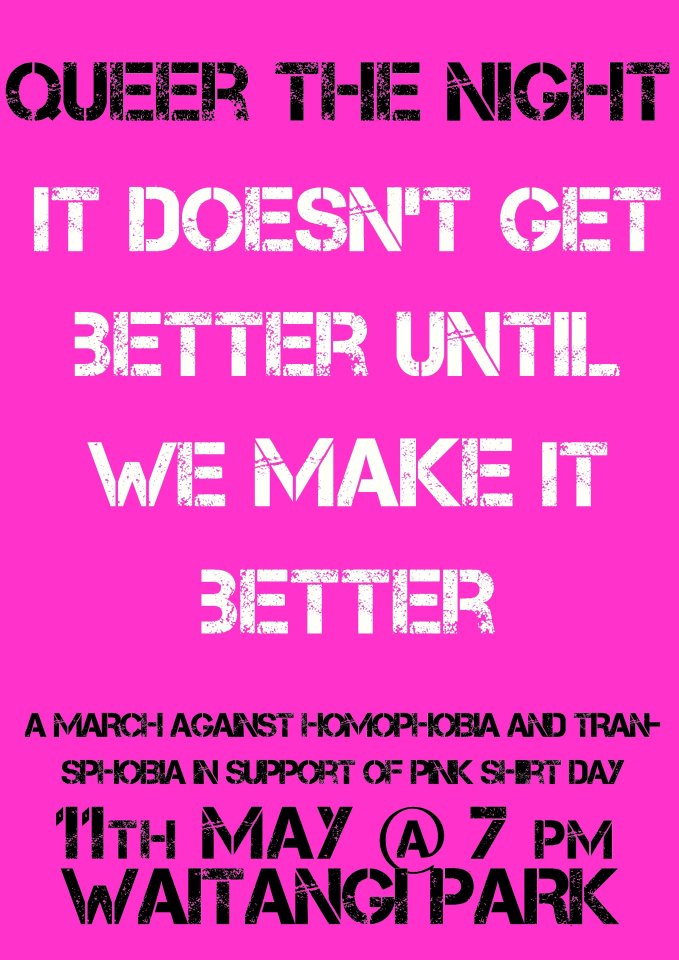
Wellington Queers the Night!

by Kevin Hodder


At least 200 people congregated in Waitangi Park, Wellington, and marched last night as part of the second annual Queer the Night march against homophobia and transphobia.

Why march? Here's some of the reasons from the leaflet created and distributed by the Queer Avengers:

“In 2011, after a series of queer bashings in Wellington, hundreds of people from the community came together to reclaim the streets, to paint the town pink & purple, to Queer the Night. Out of this march the Queer Avengers formed.

This is the annual Queer the Night march. This time we’re particularly supporting Pink Shirt Day on the 18thof May, and more generally opposing all homophobia and transphobia.

We support the formation of Queer-Straight Alliances (QSAs) in all schools. We support education on gender and sex. We demand recognition of all sexual orientations and identities. ... We’re here to say that, in schools and everywhere else, it doesn’t get better until we make it better”

After a loud and energetic march through downtown, resplendent with placards and banners as well as glitter, rainbows and sparkles, we congregated in Cuba Mall for a short series of speakers.

One woman spoke on one of the hidden issues faced by queer youth – homelessness. Intolerance within their families often means that queer youth are forced out of their homes and onto the streets, with little to no support. This only serves to compound the problem of self harm and suicide among queer youth who are often excluded from the communities that should be supporting them – family, schools, churches etc. She said “The statistics [about self harm and suicide rates] don’t matter to me. As long as one child considers self harm, considers suicide or find themselves living on the streets, that’s one too many!”


A student spoke of her experience leading a QSA in her school – “A year ago I attended the first Queer the Night and at the time I felt so alone and isolated. So much has happened to change that in the last year”, “we know there’s a problem [in our schools] – We don’t need stats”. Speaking about the role of QSAs in creating safe spaces, she said “We shouldn’t need safe spaces – our schools and communities should be doing their damned jobs!” This was reinforced by a transgender student who spoke of the 7 schools he had been through in 3 years, the friends he had lost to suicide due to constant bullying and harassment at school, and of being kicked out of his own home when he came out as considering himself male.

Kassie Hartendorp, one of the founders of the Queer Avengers and an organiser for Schools Out, spoke eloquently about the problem faced in schools. “The schools claim there’s nothing they can do – it’s just a system [they have to work through]. Well your system isn’t Fucking Working!” and that’s the real problem. Joel Cosgrove from the Workers Party said it plain – “They expect us to integrate into the current system, but why would we want to? ... We can’t rely on a broken system... We need to give our support to women's groups, to Maori groups, to immigrant groups – to all the groups that understand oppression to defeat all oppression in this fucked up system.”

Recently, Wellington news media was all over the story of two women who claimed they were ejected from a public bar for being publicly affectionate. Whatever really happened in that particular case, the reality is that every day queer people are turned away from bars and other public venues and face harassment for expressing their sexuality or gender. In our schools this takes on a different tone in the form of personal bullying, but it is no less exclusionary. In workplaces and public services, lower wages, exclusion from work and denial of services based solely on ones gender or sexuality is common. Bashings and assaults of queer and transgendered people are so common place as to scarcely ever make news. Tragically, murders in the Wellington region have made the new these last years too.

In the workplace, the streets or in our schools, discrimination kills.

The struggle to end queer oppression and discrimination needs to be part of a wider struggle to end oppression in all fields of life. “An injury to one is an injury to all”, as the Wobblies said, and it is for this reason that any struggle to create a better world must, by definition, include the struggle for queer rights and to end discrimination based on sexuality or gender.

The International Socialist Organisation is proud to have been out in support of Queer the Night in Wellington.
 
It doesn't get better until we make it better!


[Photo credit: thanks to Chloe Hitch for kindly making her photographs available to us for this report. You can view video of the rally from Andy Boreham here]

Thursday, 19 April 2012

Wellington: Queer the Night

Mark your diaries and start spreading the word: march on Friday 11th May, 7pm from Waitangi Park to protest homophobia and transphobia. More information from The Queer Avengers here. The event is also on Facebook.


[For theory and background reading see Norah Carlin's classic "The Roots of Gay Oppression", and this archive of articles on LGBTI theory and struggle]