Showing posts with label Women's Liberation. Show all posts

Saturday, 20 October 2012

Southland women need access to abortion services


To Invercargill Abortion Clinic Staff,

This is a letter of support for the essential service that you provide.  We were disgusted to find out about the threats you have received. These abhorrent messages as well as the protests against the clinic are the acts of cowards and bigots.

We fully support the opening and running of abortion clinics. We understand the necessity of such a service for women’s reproductive health and general well-being.

Such services should be made more accessible by establishing clinics in all areas, not just major cities and by making the service free for all women.

Our struggle against anti-choice bigotry must start to extend beyond defensive acts. Abortion needs to come out of the Crimes Act. For even though women in New Zealand now can get access to abortion services, the hoops which have to be jumped through and the stigma placed on women by society is not even close to acceptable.

We say no guilt, no shame for those who get abortion and those who provide the service. Your work is important.

In Solidarity


Rowan McArthur 
(International Socialist Organisation)

[Find out more about the campaign to defend abortion services in Southland by going to the Abortion Law Reform Association website. Alison McCulloch from ALRANZ debated an anti-choice spokesperson on television earlier this week.]

Thursday, 17 May 2012

Dunedin: Defending Abortion Rights


These last weeks there has been a social policy tirade against the rights of women, welfare reforms set to humiliate and degrade women on the domestic purpose benefit, reforms which target working class mothers pushing them back into work after a second child on the DPB.

Last Friday outside the Dunedin Hospital there was a different type of attack on women. A different kind of assail on a women’s right to choose. This was not the first time a group of anti-abortion campaigners stood outside the hospital harassing women and it won’t be the last.

After seeing pictures in the local newspaper of lone counter-protesters to these religious fanatics, an ISO meeting on abortion rights was organised with the highest turn out of attendants of the year. One of the people who attended  was a lone counter-protester who actively encouraged the ISO to get involved. It didn’t take much encouraging and the following morning a group of 10 ISO members and supporters turned up and stood in front of the anti-abortionists blocking the offensive and guilt-tripping signs.

At one point there would have been over 30 people arguing, criticising and ridiculing their conservative justifications for such a blatant attack on women. Most counter-protesters were students angry after walking past this protest every Friday for most of the year. Many had stopped to debate them before but never in such show of force, giving a boost of confidence to the on-going confrontation. In the current political climate where women's rights are under attack it is important to show that we will not lie down to right-wing conservative assaults on the oppressed.

This week there were expensively produced anti-abortion leaflets distributed through campuses across the country. New Zealand's abortion laws still force women to go through too many hoops to access a service that should be freely available on demand.

Our counter-protests continue, and this photo shows today's picket in support of women's rights. Abortion: a woman's right to choose.

Rowan McArthur

Sunday, 6 May 2012

The Tyranny of Slenderness


By Rowan McArthur


The body often shows us the physical manifestation of the brunt of our physical, emotional and spiritual exploitation under capitalism. Just as a worker in a factory may be cursed at by their bosses for not working fast enough because of pain in their hands and backs from hours of repetition, so too do we get cursed and abused by capitalism for our bodies physical manifestations of the exploitation we experience in our everyday lives.

Everywhere we look we see the image of the perfect body, an emaciated body is projected onto us by this exploitative system as a way to repress the majority who cannot conform. An emaciated body, representing the emotional, spiritual, mental and physical hunger we all experience under an economy based on exploitation and profit, rather than human need. A body that everyone wants but no one can achieve; for this body is not real. Just as the body on the billboard advertising the latest fashion, has been warped, cropped and coloured to trick us into believing that the emaciated and sick is beautiful, so too does capitalism warp, crop and colour our exploitation to blind us of the reality of this sick and corrupted system. This body dominates our thoughts and conversations as well as those who judge us by it. It dominates how we feel about ourselves. It dominates our television screens and creates huge amounts of profit for fashion, weight loss clinics, pharmaceutical companies, cosmetic surgeons and other parasitical industries feeding off the vulnerable. This body represents perfectly the unsustainable system which dominates our world, but sadly it also represents the domination and emotional hunger experienced in many peoples lives.

This is the tyranny of slenderness!

This emaciated body has not always been the ideal for women to conform to. There was a time under capitalism that a curvaceous woman was the picture of beauty. So why has this changed? Why do so many women strive for the pre-pubescent, boyish figure which we are brainwashed into thinking is normal for a grown woman? Why do almost all women think that a size 12 is fat? Why are most women not happy with the way they look? Why do we live in a society where people starve themselves to death or eat themselves into oblivion?


There are so many places to point the finger too, but more than often we point it ourselves or at one another rather than pointing it at those who impose their ideologies upon us for their own benefit. How often do we judge those people walking down the street who do not fit in the box of a healthy weight? All too often there are snide remarks and laughter which follow those who are overweight or gasps and looks of horror at those who no longer eat. Both those who eat to a point of excess and those who starve themselves are representing the lack of control we have over our lives. Some people feel that the only thing they can control is what they eat and so when they realise they cannot control any other aspect of their lives they restrict themselves from participating in one of the fundamental acts of keeping ourselves alive.

The anxiety girls and women experience from feeling unattractive is arguably one of the most pervasive and damaging consequence of advertising and mainstream media. Only one body type is almost always presented in the media and in advertisements -- that of a very tall,thin woman -- a woman who would meet the criteria for anorexia as 15% below normal weight. In reality, this unhealthy body shape is unattainable for 99% of women.

Eating disorders are a symptom of a sick society.  A society that celebrates thin women in the media, advertising, film and chastises women deemed overweight. 'A WOMAN can't be too rich or too thin.' So said the Duchess of Windsor, and so says every fashion and beauty magazine, every television ad, every weight loss centre and even many families, friends and doctors.


The most well-known eating disorder, anorexia nervosa, is the third most common chronic illness among young women. Anorexic women suffer from the perception that they are overweight, when they are in fact often dangerously thin. Other common eating disorders include bulimia nervosa, in which a person binges and then purges themselves (usually by self-induced vomiting), and binge eating, in which a person cannot control their desire to overeat. While some men experience eating disorders, over 90% of people with them are women.

Naomi Wolf’s book The Beauty Myth (1990) powerfully documents the effects of the unattainable body ideal on women's physical and mental health, and indicts the fashion, cosmetics and plastic surgery industries, which benefit from women's misery to the tune of billions of dollars a year.

These profits are made by creating a deep sense of dissatisfaction amongst millions of women about their bodies, a dissatisfaction that is growing with the growing gap between the 'ideal' body and reality.

Media images do have a powerful effect, but they are also continually reinforced in everyday life. Comments on women's appearance are so commonplace and accepted that we can underestimate the effect they have on how women see themselves.

These powerful media images indicating a thin women is a good women are affecting people at a younger and younger age. In some disturbing statistics presented by the British journal of psychology half of three to six-year-old girls say they worry about being fat. By the age of seven, 70 per cent of girls want to be thinner. By nine, half have been on a diet. For girls aged between 11 and 17, its their number one wish in life. This may seem surprising, but when you think of the images seen in advertising, billboards, magazines, films and TV which glorify and focuses on thin actors, actresses, models and other successful and important figures it doesnt seem so surprising after all.

In a study of childrens movies and books for messages about the importance of appearance, media targeted for children were heavily saturated with messages emphasizing attractiveness as an important part of relationships and interpersonal interaction. Among the movies used in the study, two Disney movies contained the highest amount of messages about personal beauty. This study also found 64% of the videos studied portrayed obese characters as unattractive, evil, cruel, unfriendly, and more than half of the portrayals involved the consideration or consumption of food.

Representation of overweight individuals in prime time programming is not representative of the actual proportion in the population. Only 14% of females and 24% of males featured in the top ten prime-time fictional programs of 2003 were overweight. Those that were shown had few romantic interactions, rarely shared affection with other characters, and were frequently shown consuming food.

Many times, even these "beautiful" women are deemed not good enough for advertisements. Photographs are airbrushed or otherwise altered to remove any lines, bumps, or lumps - anything less than "perfection." If the ideal of beauty is physically unattainable, then consumers will never be able to attain the image they want, and therefore there will be an endless demand for new beauty products.

This is the reason for the incredible proliferation of the weight-loss, fashion, and cosmetics industries, which are among the largest and most profitable consumer industries.

As a result, the millions of women and girls who are unable to reach this standard of beauty feel a sense of failure, shame, and guilt. In 1984 a survey of 33thousand woman was taken showing that most women would choose loosing 5 to 7kg over success in work as their most desired goal. This clearly shows how this desire to be thin infiltrates out from womens individual lives into the advancement of their careers, participation in their unions and the political arena. Naomi Wolf describes dieting as the most potent political sedative in womens history. The concern about weight leads to a virtual collapse of self-esteem and sense of effectiveness in womens lives.

This change in perception of womens ideal body came into being as a dominant feature of womens everyday lives can be linked to womens liberation movement of the 60s and 70s. The Womens liberation was leading to a more assertive, politically clear, self-confident woman, the opposite traits of women concerned about their weight. What Naomi Wolf describes as caloric restriction was a means to take the oomph out of our desires to be treated as equal and has warped the struggle for our liberation from a mass movement into an individual struggle against our own bodies.

The distorted, unattainable, sexist mass images are a product of the exploitation of women as wage workers, unwaged domestic labourers and sex objects. They are an inevitable consequence of (and prop for) a system in which those with power benefit from the exploitation of women in the home and the workplace. Undermining women's self-confidence not only keeps them buying more and more products in their struggle to attain an ideal, but also helps to keep them from challenging their roles.

Campaigns to change the images without changing the social conditions which produce them and give them their power can advance things only so far. Legislation to ban particular types of advertisements, or regulating the size and shape of fashion models, doesn't challenge the basis upon which it is so lucrative for industries to use such images to sell their products.

The most effective way to combat sexist images is to develop a mass movement which aim to change women's unequal living conditions in a whole range of spheres and out of which alternative images, will develop. This will also challenge the nuclear family structure, the unpaid work in the home which the majority of women undertake and the pay gap between women and men. But further than this womens liberation cannot be achieved by women alone, it has to be a part of a working class movement, intent on creating equality for all oppressed groups not just for women. A working class movement is the only way to completely topple and smash this tyranny of slenderness!


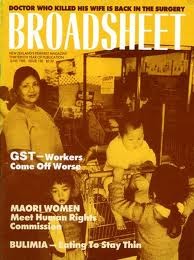
[An image of Broadsheet, New Zealand's pioneering left-wing feminist journal. The women's liberation generated a whole array of radical publications, theories, and organisations.]


Wednesday, 21 March 2012

Nationalise Oceania!


Low paid aged care workers and nurses were out on strike again on 19th March. The action was at 22 out of Oceania’s 57 homes, which are run on public money for private profit. They have our full support. Their stand is an example to other workers, and shows that workers in all industries can stand up and fight back. 

Oceania pay their care givers an appalling basic rate of just $13.61, a smidgen above the minimum wage that will be $13.50 from April. Qualified nurses are paid more of course, but less than in the public sector. They only get $8.33 on top of basic when they work a weekend shift.  Oceania’s latest offer is a miserly 1.72% increase, but only from February and not backdated to last June when the last collective agreement expired. But the offer is worse than even this because Oceania want to cut overtime rates.

As paymasters the government are partners in this crime. Oceania got a 2.6% increase in their public funding last June but refuse to pass it on to staff pay. In a labour-intensive service industry John Key is effectively capping pay to below inflation levels.

What should be done? For starters the union movement should raise a storm of protest and not leave the Oceania unions SWFU and NZNO to battle on alone. The SWFU and NZNO strikes are an inspiration, and have drawn others into the  union and into struggle. Two SFWU delegates from Oceana spoke to a Unions Wellington meeting last Friday and talked of the determination of union members on the picket lines. But the care givers left to fight by themselves have little industrial power, and illegal solidarity strike action by workers in sectors with greater power is unrealistic. However, the Council of Trade Unions (CTU) and all unions could back the strikers’ public protests to the hilt by calling on members to join in. We marched with the watersiders, we can do the same in town after town with the Oceania workers and the elderly folks’ families.

It is not only the greedy Oceania owners who need to be exposed. The politicians are responsible for the elderly care service being run for profit. Quite simply Oceania and the other private outfits should be nationalised without compensation. The public already pay for the care for the elderly. Why should profit be skimmed off at the expense of poverty pay and minimal standards? Those false friends of workers, the Labour Party, could make nationalisation a manifesto policy and pledge to make elderly care the quality public service it should be. Keeping the status quo means condemning women care workers to poverty pay indefinitely, because that is what privately contracted publicly funded services are designed to do. Only as a public service could women care workers ever get the recognition they deserve for a demanding job that, let’s face it, few men have the skills to do. Unless Labour, and the Greens, take up the call for nationalisation their support for the care workers is nothing but hogwash.

There is another false friend abroad, and that is the call for New Zealand ownership. Bryan Gould wrote an otherwise excellent piece on the dispute, but lamented that Oceania was Australian-owned (New Zealand Herald, 14 March 2012).

“Like most overseas owners, Oceania have little knowledge of and even less interest in the welfare of their New Zealand workers - to say nothing of New Zealand customers and taxpayers.”

“The real goal of privatised companies is profit, not service. We cannot prevent privatised firms - despite the government's obfuscation on this issue - from falling into foreign hands. Enterprises owned overseas have little concern for the interests of their workforce. New Zealand workers are increasingly at the mercy of hard-nosed employers.”

Quite frankly this all-New Zealanders-together nationalism is nonsense. The for-profit elderly care service is a made in New Zealand construct. It operates under New Zealand made anti-union labour laws. There is no evidence at all that New Zealand employers are better to their workers than Australian; in fact it would be easy to make an argument to the contrary. But it is not a question what set of employers have better morals because all capitalists have the same immorality, to exploit and make the most profit possible. The New Zealand ruling class is as greedy as any and gets away with it more than most. The main enemy is at home. The real question Bryan Gould should be asking is how do we build a workers’ movement powerful enough to get rid of the profit system.

Pay the Oceania workers’ 3.5% claim today!

Nationalise the elderly care service and pay women a living wage tomorrow!

[Photo Credit: Service and Food Workers' Union website. Look out for details of how to support the strike action coming on Easter Thursday, 5th April]

Wednesday, 7 March 2012

International Women's Day


by Shomi Yoon

Today - March 8th - is International Women's Day. The demands of the Women's Liberation movement - for free, safe, and legal abortion on demand; for free contraception and women's rights to control their bodies; for equal pay; for liberation from sexual oppression and discrimination - have lost none of their relevance today.

Educate


while Joyce Stevens' History of International Women's Day in Words and Images has much useful information. This week's Socialist Worker (UK) carries an interesting interview with Cathy Porter about the Russian revolutionary Alexandra Kollontai, socialism, International Women's Day and liberation. Find out about the history of International Women's Day.

Sandra Bloodworth argues here on the connections between women and revolution, while Sarah Garnham makes the case that sexism is systematic. There is an archive of sociaist articles on lesbian women's struggles for liberation here.

Janey Stone has written on the 'Real History of International Women's Day'

Get Active


We need to fight sexism in the here and now - in our own lives and in society - and to look for collective action to push for women's rights.

Strong unions need strong women: support our sisters in the Maritime Union of New Zealand today by backing them in their fight, with their male workmates, to Save Our Port, and donate to their campaign here. There are women workers in the Meatworkers' Union currently locked out or on strike in support of their locked out brothers and sisters -- they too need solidarity.

An international union federation for food and allied workers' groups is using International Women's Day to promote their campaign to stop Nespressure, against Nestle's treatment of women workers and unionists in their factories around the world. You can find out more here.